How to Simplify Your Home and Life For More Time, Energy, and Mental Capacity


Simple living is really about getting your life's resources back.
Time. Energy. Mental capacity.
Most of us are running short on all three, and the stuff piling up in our homes is only part of the problem. The other part is how we're running our days.
When I'm thinking about how to simplify something, or how to make my life feel calmer and easier, I keep coming back to the same three things I want.
I want more time back so I can invest it in things that make me happier.
I want more energy so I can actually enjoy that time.
And I want some mental clarity, because I feel most grounded and centered when my mind isn't full of jumbled-up noise.
There are some common themes that show up again and again in my content, and they all map back to those three things.
- Decluttering and minimalism clear the excess so you gain back time, energy, and mental clarity (clutter pulls on your brain more than most people realize).
- Systems, habits, and routines make daily life run without constant effort, so those resources stop leaking out.
- And slowing down, so you can actually enjoy and appreciate the moments when you're in them instead of burning through your energy rushing from one thing to the next.
If you're still in the thick of the clutter itself, start there. Everything here builds on clearing it first.
Start With Your Space
Most productivity and habit advice skips the environment entirely. It assumes you can just decide to be more disciplined and follow through. That's not how it works for most people.
The research is pretty clear on this. Behavior follows context more than it follows intention.
When the right thing is also the easy thing, it happens. When it requires fighting your environment every single time, it eventually doesn't.
Your physical space is the most underrated lever you have. The whole idea behind designing your space to build habits without willpower is making the right behavior the easy default, adding friction to what you want less of and removing it from what you want more of.
Keeping fruit and healthy snacks out on the counter instead of buried in a fridge drawer means you reach for them without thinking. Leaving open floor space in a room makes it easy to roll out a mat and move your body without having to clear anything first.
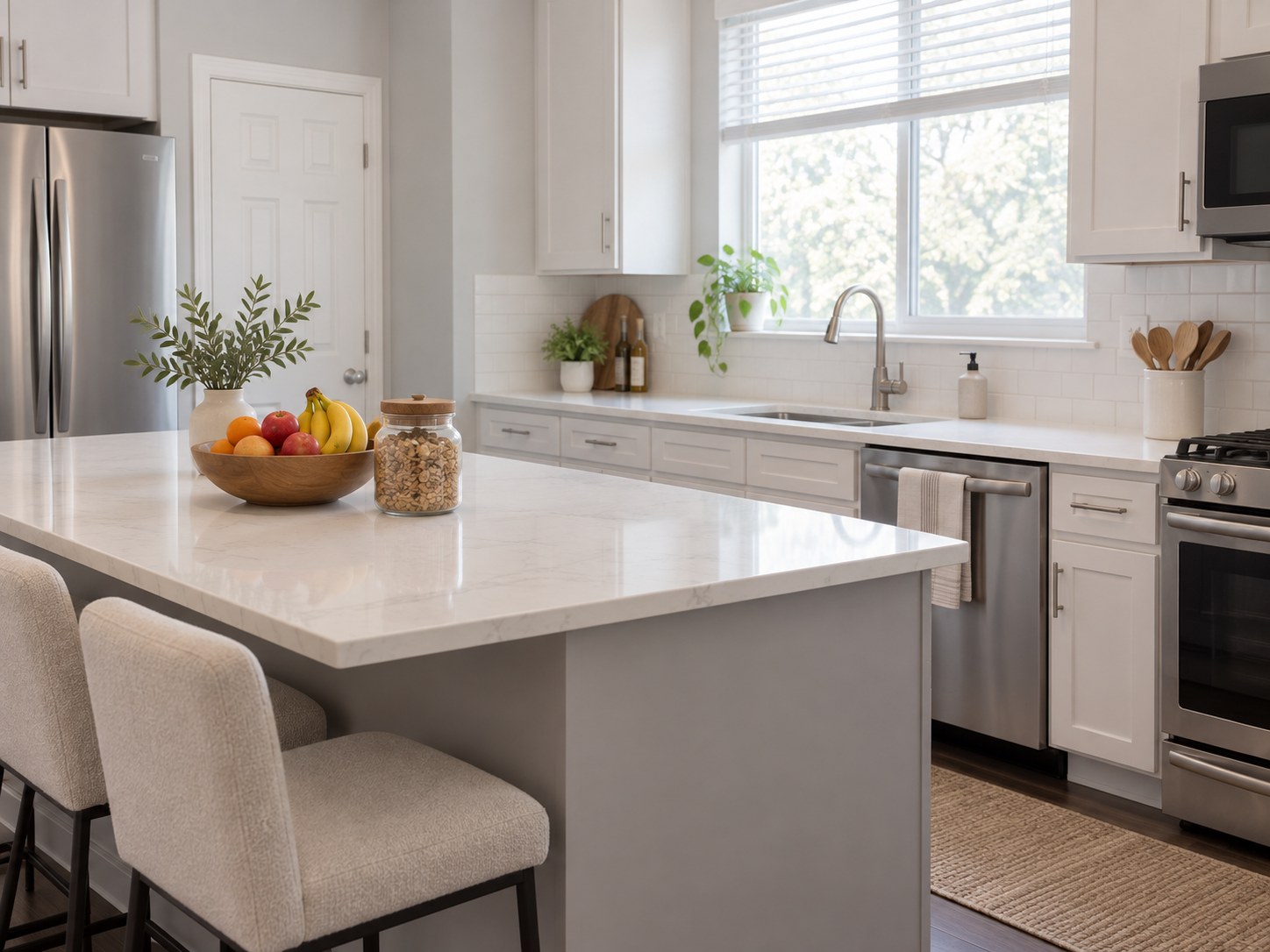
Your energy stays intact for the things that actually matter.
The other half of this step is structure. A simple space has dedicated zones, where each activity has its own place and everything you own has a home to return to.
That structure is what makes a room feel calm instead of chaotic, because your eyes and your brain always know where things belong. Building spaces that are intentional and supportive starts with deciding what each area of your home is actually for.
Starting small is the way in for most people. Something as simple as keeping only two pairs of shoes out by the door means you never have to hunt for them, and the floor stays clear without anyone having to think about it.
Small tweaks like that are enough to feel the difference before you commit to anything bigger.
Build Routines That Build Simplicity
A routine only simplifies your life if it survives real life. I've had seasons where my daily rhythm was tight and everything ran well, and seasons where it fell apart completely.
The version that stuck had fewer steps and smaller goals, and it was realistic enough to survive a hard week.
The other thing that made a routine hold was doing it with intention instead of on autopilot. A routine is just something you do, and choosing to do it on purpose is what turns it into something that sticks.
For example, I set the intention that walking up and down my stairs is how I get my steps in.

My posture literally changes on the stairs now because I treat them as something for my health instead of an obstacle between me and a refilled water glass.
Same task, completely different relationship to it. Learning to turn mundane routines into meaningful rituals changes how they feel enough that they actually stick instead of fizzling out by week two.
So a routine that builds simplicity is a simple one, done on purpose.
Start With the Morning
The morning is where the whole day gets set up or derailed, since how you start tends to set the tone for everything after it. I'm not an early riser and never have been, but I give myself at least 15 minutes to wake up before rushing into tasks.
That buffer is non-negotiable.
My own morning routine isn't something most people would call impressive. It's hydration, getting outside with Charlie, and easing into work rather than being thrown into it.
The whole point is keeping the morning from becoming the thing that derails everything else.
Hold the Day With One Simple System
Once the morning isn't working against you, the next piece is somewhere to hold the day's plan. A to-do list on its own has never been enough for me, so I lean on one place that holds my planning, journaling, and priorities together.
The real power is in the habit of journaling what's on your plate, reviewing it honestly, and deciding what actually deserves your time.
There are tons of systems that do this, and the best one is whatever you'll keep coming back to, so try a few until something clicks.
The one I use and love is the bullet journal method. Rapid logging keeps it simple, a dot for an action item, a circle for an experience, a dash for a note, and it holds a full life in any plain notebook.
What sold me is the migration habit built in, where you review what you've logged and decide what moves forward and what gets dropped.

If something keeps getting shuffled from one week to the next without ever getting done, that friction is the method's way of asking whether it needs to happen at all. That filter alone changed how I manage my future time.
Let Small Habits Do the Maintenance
Once the day has a shape, small repeatable habits are what keep it from unraveling. They return time and mental space without asking much of either.
Take immediate re-homing. When you use the can opener, you put it back rather than setting it on the counter to collect with 20 other things later.
It takes two seconds and saves the drain of a surface that always looks like it needs attention. Or organic decluttering, where you do one small thing wherever you already are, like pulling one expired product while you're brushing your teeth.
Another I lean on hard is heat mapping, grouping similar items together and moving them to a used pile as you reach for them. After a month, what's still sitting in the original group is what you're not using, which makes letting go almost automatic.
The habits I come back to most all run the same way, low effort, high signal, no willpower required.
The same thinking stretches past the house, into sleep, movement, single-tasking, the daily behaviors that compound across a whole life rather than just a home.
This maintenance layer is what keeps all of it from becoming a recurring project. These simple daily routines let the home hold steady so you're not constantly resetting, which frees up the mental capacity for things that actually matter.
Let Your Systems Do the Work
Routines are what you do. Systems are how your home and life are set up so that the right things happen without having to think about them every time.
The difference matters because routines require you to show up and execute. Systems work even when you're tired, distracted, or having a hard week, because the structure does some of the work for you.
When the structure is doing the work, your time and energy stop leaking out of a hundred small decisions you didn't know you were making.
What This Looks Like in My House
Taking Charlie out is my favorite example. Four people in the house, four scheduled slots, and if a walk gets missed, we all know exactly whose slot it was.
People assume that kind of scheduling is uptight, but it works the opposite way. Nobody nags, nobody simmers about who isn't pitching in, and Charlie's care never falls through the cracks.
Dinner runs the same way. Everyone claims two meals a week to cook, we still eat together five nights, and my oldest has turned into a better cook than I am.
The list runs from the five-minute rule (any task that takes five minutes or less gets done immediately, before it joins the pile of things nagging at you) to Pinterest meal boards divided by type so there's one place to go instead of ten.
The ones that actually hold up are just what works day to day.
Smart home tools have made a crazy difference. Linking Alexa to the family calendar means the girls can ask when their next orthodontist appointment is without me, which means I'm not carrying that information in my head.
The hacks that actually cut friction are the ones I keep.
Protect Your Time and Mental Energy
The way you use your time is deeply connected to the way your home runs. A cluttered, chaotic environment makes every decision harder and every task take longer.
The reverse is also true. Better systems at home free up mental energy that shows up as more productive, focused work.
Most people think of productivity as a personal discipline issue. A lot of what looks like a motivation problem comes down to cognitive load.
When your environment is demanding constant micro-decisions just to function, there's not much left over for anything that actually requires focus.
Make the Decision Once
My favorite proof is a study that tracked over 1,100 parole hearings in Israeli courts.
Judges granted parole far more often early in the day, and as the decisions stacked up, their default moved to denial. That's decision fatigue at work.
The easiest answer is always "no" when your brain is tired.
Psychologist Roy Baumeister said that every decision is like doing a mental push-up. Most people don't notice how many push-ups their home is demanding before lunch, and the science of decision fatigue is one of the most concrete cases for a simpler home because of it.
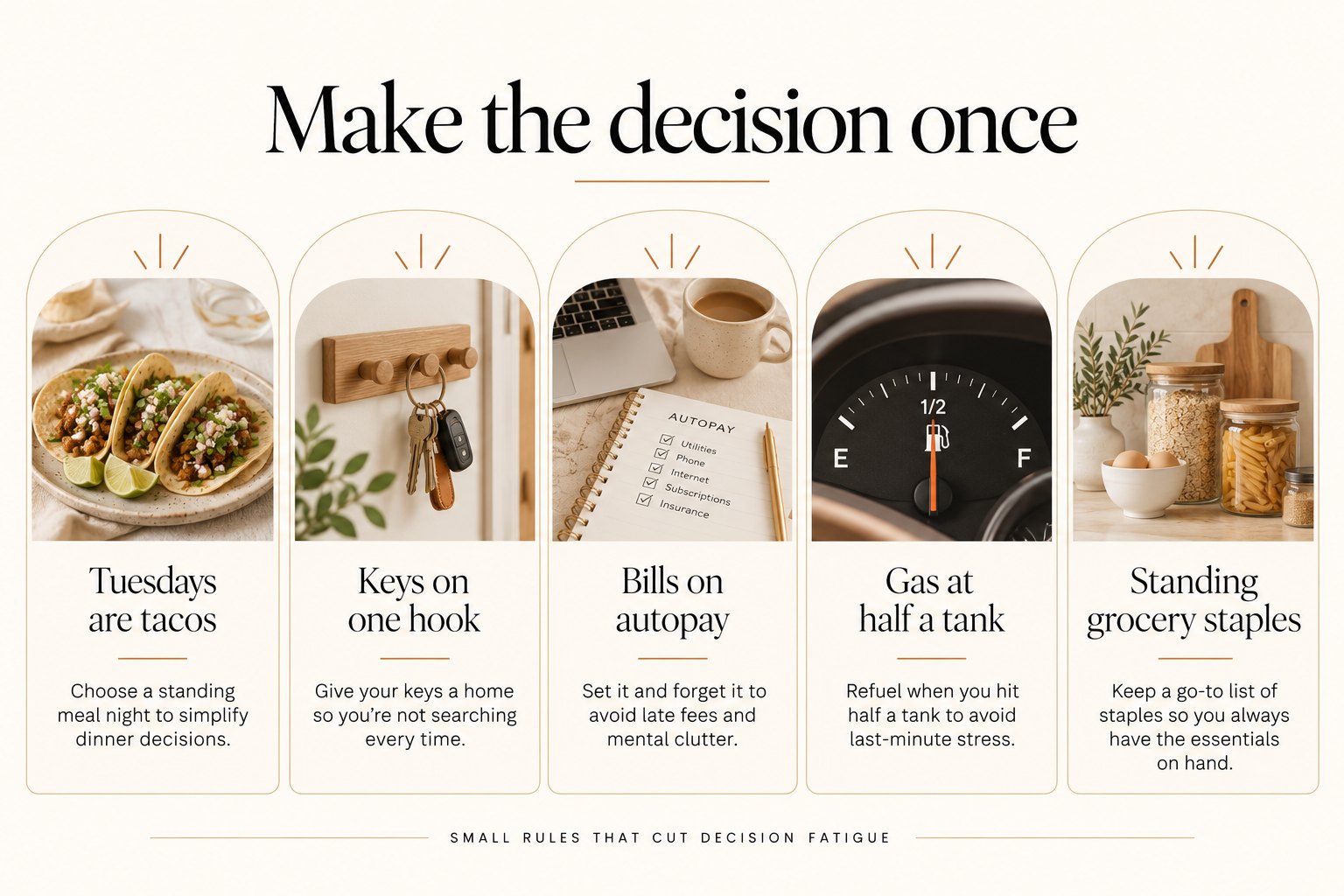
The fix is deciding once instead of daily.
- Tuesdays = tacos.
- Keys and bag live on one hook by the door, so leaving the house never starts with a search.
- Every bill on autopay, so due dates never take up a thought.
- A default gift for kid birthday parties, bought a few at a time.
- Gas when the tank hits half, so it's never an emergency.
- A wardrobe where everything goes with everything, so getting dressed isn't a matching puzzle.
- Standing grocery staples that get bought every week without checking, only the extras change.
Those little pre-decisions sound almost silly, but they protect a crazy amount of brain power over a week.
Batch, Then Subtract
Time batching is one of the highest-leverage changes I've made. You group similar tasks and let your brain stay in one mode instead of switching in and out all day.
I resisted it for years and now can't imagine working any other way.
The switching itself is the hidden cost. Princeton research found that each extra task you juggle compounds, and by the time you're bouncing between five of them, about 75% of your efficiency is gone.
The next lever is subtraction. About 20% of what you do produces most of the results, so the highest-return move is cutting the busywork that fills the other 80%.
Batching keeps your brain in one mode, and subtracting shrinks what's in that mode to begin with. Add a few simple work rules on top and you can double your productivity without adding a single hour to your day.
That's how it works on a normal day. Real weeks also come with days that don't cooperate, and they come in two flavors.
There are the days you're running on empty, and the days you can't get started at all.
When you're running on empty, the answer is a much smaller list. The night before, I write down the two or three things that would actually cause problems if they slipped, and everything else can wait.
And when the problem is getting started at all, that's procrastination, which gets treated as a character flaw.
It's usually a protective response, and the higher the stakes feel, the stronger it shows up. Once you see it that way, working with it instead of white-knuckling through starts to feel possible.
Quit What Drains You
Simplifying is about more than adding structure. A huge part of getting your mental capacity back is identifying what to stop doing and stop owning, so there's less to manage in the first place.
This is one of those things that sounds obvious and is actually hard to act on.
It's easy to add a new habit or tool. It's harder to look at what you're already doing and decide it doesn't belong in your life anymore.
That includes the projects you have going at once. I keep it to a couple at a time, because every open project is an open loop your mind keeps checking on even when you're not working on it.
And house projects count here too. There was the week all the cabinet doors were off in my kitchen and cans of paint were living on the counters, at the same time Gracie had a sculpture assignment, a model home that needed its own space and materials out.
We can't have five of those going on at once or it would be mayhem.
Cutting back or quitting things isn't always physical. I've shared things I've quit to simplify, and many of those are more closely related to mindsets than projects.
A lot of them were commitments and habits, like moving every bill to autopay or letting go of the morning alarm, that cost more than they gave back.
I revisit that question every year. This year's list came down to five things.
The throughline this year was deeper connection. That meant aligning where my money and attention go with what I actually want, rather than letting my bank balance decide.
Clutter goes beyond the physical. The four areas to work on are your mind, your home, your emotions, and your schedule.
Your schedule is where you spend your energy just as much as your home is where you draw it, and both matter.

Give Focus and Rest Their Own Space
When the same space holds your work and your rest, the two start to bleed into each other. How your home is set up decides whether either one actually works.
This is most obvious when you work from home and your office is also your kitchen, your living room, and homework central. Giving each its own space makes it easier to be present while you work and easier to switch off when you're done.
The good news is that a dedicated office room isn't required. A cleared corner does the job, with a chair that actually supports you and a workspace where everything present earns its place.
From there, make that corner somewhere you want to sit. Color and light do real work here, cool tones to settle a restless mind, warmer pops to wake up a sluggish one.
The setup is only half of the equation. The other half is a daily rhythm that keeps you thriving while you work from home.
And when the workday ends, leave work in its corner. That's what lets the rest of your home do its other job, helping you actually rest.
Leave Room to Slow Down
Everything above clears time, energy, and mental capacity. The point is to actually use some of it.
Slowing down is the step most people never actually get to. A simple home gives you enough time, space, and calm to be mindful, and none of that matters if every reclaimed hour gets refilled with something new.
For me it's built into the day in small ways rather than saved for someday. The 15-minute buffer before the morning starts, getting outside with Charlie, an evening with nothing scheduled after dinner.

Tiny self-care habits at home like these are what the reclaimed time is actually for.
A Simpler Home and Life
The end goal with all of this is bigger than an organized home.
It's getting your time back. Your energy back. The mental clarity that makes you feel like yourself again.
When there are enough systems and rhythms in place, maintenance becomes part of daily life rather than something you have to block off a weekend for.
The home doesn't fall apart when you have a hard month. It holds steady and picks back up when you do.
I've tested what holds under real pressure, a sick kid, a launch week, stretches where I was barely keeping the essentials going. The systems that survived were the simple ones, the ones that still work when you're running at 60%.
When things have slipped further than usual, the way back in shouldn't feel like starting over. Running the same reset in the same order every time, money and calendar before the house itself, builds momentum faster than trying to fix everything at once.
And when a new season calls for a bigger clean slate, the same five steps show you how to reset your life from your head to your home.