Getting Started With Decluttering
Search "how to declutter," and you'll hit a hundred conflicting methods before you've picked up a single thing. The challenge at the start usually isn't effort so much as not knowing where to begin. Or figuring out where you even fit in with all of the advice out there.
Underneath it is the mental load of living with too much, the way a full home pulls at your focus and mood all day. Feeling what clutter actually does to your brain is usually what turns "someday" into "today".
It's ok. Getting started with decluttering is less about one perfect method and more about knowing which problem you're actually solving. So, I created the map below to help you find your place and show you where you can go deeper, wherever you are.
Start Decluttering by Asking the Right Question
Almost everyone who wants to declutter is really asking one of two different questions, and they need different answers.
The first is a 'what' question. If you're standing in a room where nothing jumps out as obvious clutter, but it still feels like too much, that's a 'what' question. Having steps and a flow of rooms doesn't help if you have no idea what to let go of within those rooms.
If that's you, I created a post on what to declutter for every situation, built for exactly that.
The next is a 'how' question. If you feel stuck on the process, the room-by-room steps, the methods, or how to move fast without burning out, you're getting started with the 'how' of decluttering.
You'll want to start with the full how-to guide that covers everything right through to getting the stuff out the door.
The First Move That Changes Everything
The biggest beginner mistake is picking up one item and spiraling into its whole story, where it came from, whether you could sell it, why it's still here. Five items in, you're exhausted, and the room looks the same (maybe even worse).
I'm a firm believer that decluttering through a process of selecting over sifting is the power move of all decluttering.
Focusing on what you want to keep, rather than digging through things to remove, puts you in a position of power because you're choosing what belongs and controlling your energy in the process.
Let everything else fall away by default. This counterintuitive first step starts to feel almost easy once the pressure of justifying every object is gone.
When Letting Go Feels Hard
Sometimes the holdup isn't the process at all. You sit down, ready to clear a space, and just can't bring yourself to let go of anything. That resistance has roots that have nothing to do with the item in your hand.
Putting a name to what's underneath is usually what loosens the grip, and the reason the clutter won't budge is more often emotional than logistical.
Why It Keeps Coming Back
If you've decluttered before and watched it creep back in, the rerun isn't a willpower failure. Clutter follows predictable patterns, and the stuff returns through the same few doors every time.
Spotting your own pattern is what finally breaks the cycle, and the real reasons you have so much stuff tend to be more about habits and beliefs than about the objects themselves.
Decluttering Is One Piece of a Bigger Picture
Decluttering on its own tends to be temporary because the physical clear-out is only one layer of the work. It's like 20% of the whole process that leads to maintaining a clutter-free space.
The process I teach moves through all of the layers: your mindset, the emotions that make letting go hard, the physical decluttering, the energy of a space, and the maintenance that keeps it from rebuilding.
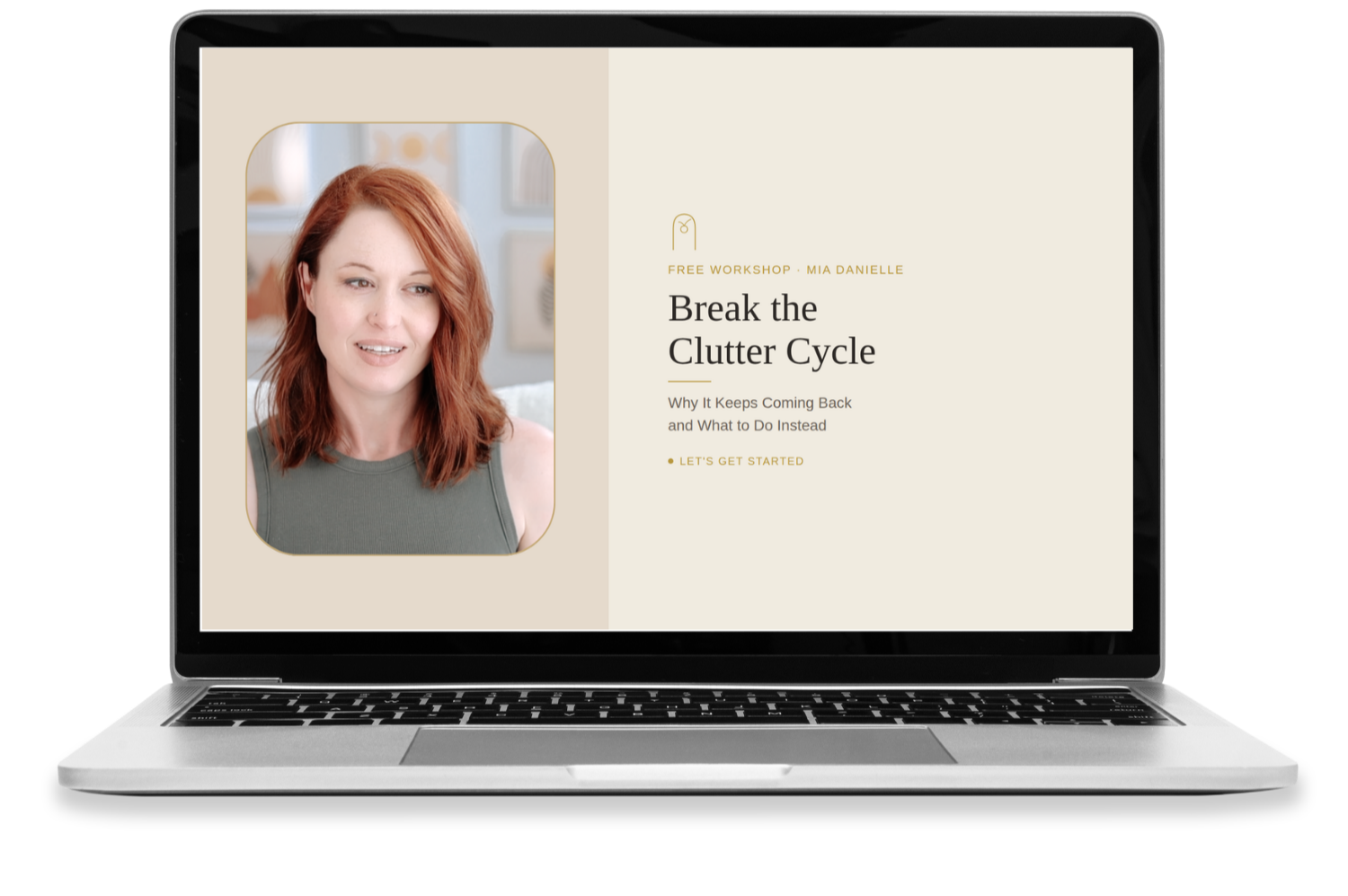
Walking through the whole thing in order is exactly what I do in my free workshop, where I break down all of the pieces and how they work together for a truly holistic decluttering process.
Keeping It Clear Without Constant Effort
The hardest part for most people isn't the first clear-out; it's keeping it from sliding back six months later. That comeback rarely happens from one big failure, but when nothing is set up to catch the daily drift.
A home that holds steady runs on a handful of systems and rhythms doing the work in the background, which is what building habits and systems that stick is really about.
Branching into Minimalism
Decluttering at the next level is where minimalism fits into the picture. I consider minimalism, at its core, to be a practice of awareness and intention regarding your belongings. Obviously, this goes beyond decluttering the junk drawer.
Minimalism gets treated like an aesthetic or ascetic lifestyle (which it can totally merge with if the person chooses), but just like everything else related to simple living, the goal isn't the practice itself but the result.
Typically, the goal is more energy, time, and mental capacity.
It's the whole reason I keep pointing people back to what minimalism actually is, kids and full lives included.
The Whole-Home View
Past a certain point, this stops being about stuff and starts being about how a space makes you feel, your energy, your nervous system, whether a room actually lets you rest.
A decluttered home is the foundation for that, and a home that supports you instead of draining you is where this whole thing has been headed the entire time.
Just Get Started
You don't need the perfect plan or a free weekend. Follow the frustration or pick the room you look at most, choose one surface, and select what stays.
One cleared surface you see every day does more for your motivation and momentum than a whole closet you never open. The first tiny win is usually what makes the rest feel possible.