How to Declutter: Methods and Mistakes
Every decluttering strategy I trust enough to teach lives on this page.
We're breaking down the most important methods, the mistakes that undo them, and how to handle the sessions and situations that don't go according to plan.
It's a big overview on purpose. Everything we touch on links to a deeper dive, so when a section hits your exact situation, the full breakdown is one click away.
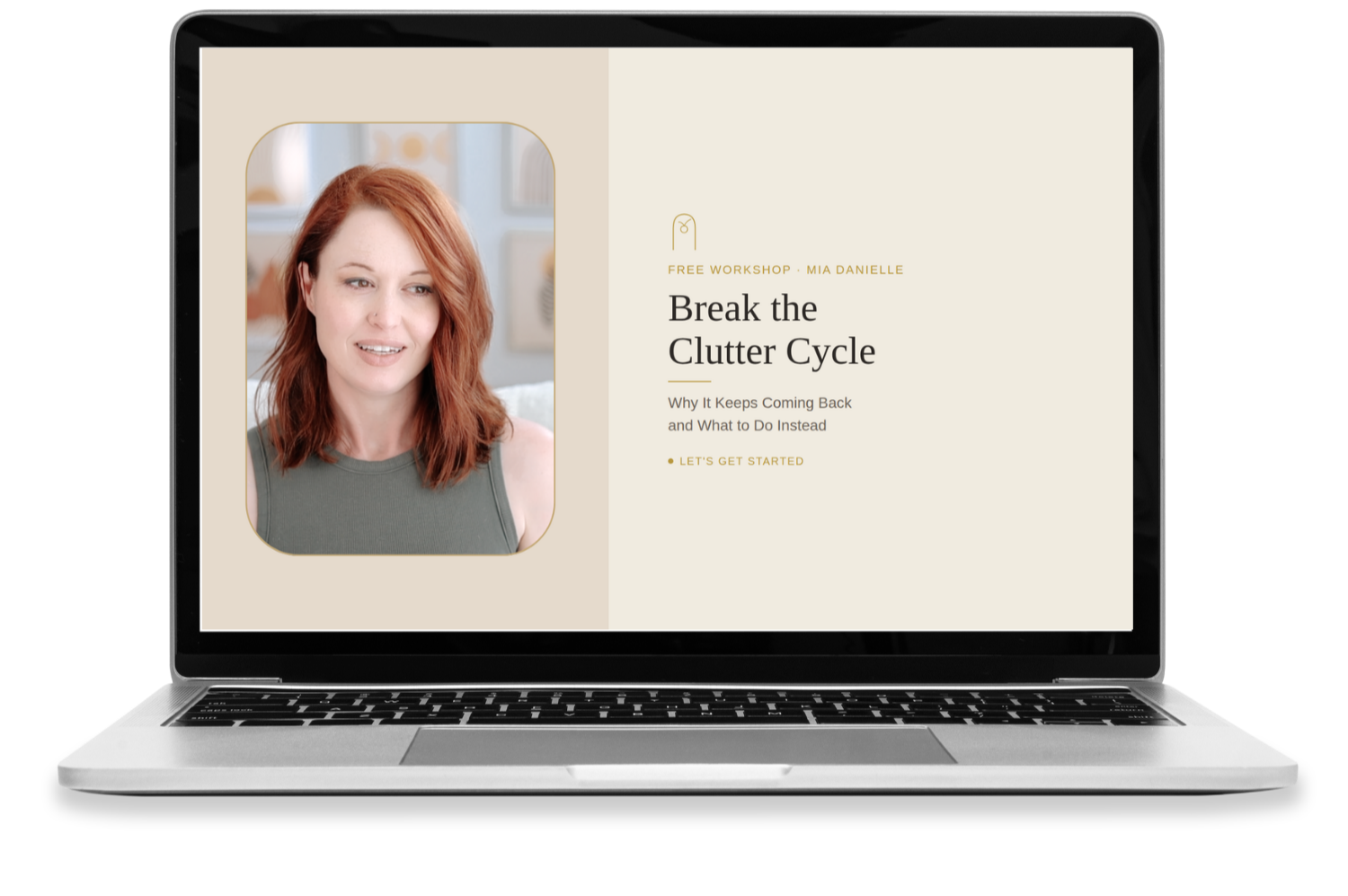
The mindset, emotional, and energy side of all this is something I go deep on in my free workshop, where we break down the five ingredients every clutter-free home needs to actually stay that way.
Decluttering is one of those things that feels simple from the outside and completely different once you're standing in the middle of a room with no idea where to start or whether what you're doing is even working. If you haven't picked a starting point yet, getting started with decluttering is the step before this one.
Most people who land here already know something needs to go. If you're still in the "do I even have a clutter problem?" phase, 50 signs you have too much stuff will make the call obvious, and knowing what you're actually dealing with makes the how a lot cleaner once you start.
Strategies and Methods
Start With How You Work, Not What You Own
There's one concept to understand before you touch a single room, and it will save you hours: working in modes.
Most people start cleaning the kitchen, find a shoe that belongs in a bedroom, carry it there, spot a disaster, start dealing with that, step on a damp towel, detour to the bathroom, and two hours later haven't finished a single space.
This is context switching, and it's the number one killer of efficiency.
Working in modes means choosing a single function, getting hyper-focused on that one action, and completing it throughout the entire house before switching. That could mean working in categories or by the type of task.
Removing all expired products everywhere. Tending to all things dish-related. Or my personal favorite, consolidating duplicates into one bottle, container, or bin (it feels so good).
That last one immediately saves you at least 50% of the space, sometimes more.
The brain doesn't have to keep reloading with every new task. You finish one thing before moving to the next.
I love this approach so much I built an entire checklist around it. Modes is just one of the rules in my 10-point checklist for managing clutter, alongside a few others that make the whole thing a hell of a lot easier to get through.
Working in modes is also something I go deep on in Clutter Cure, where we take strategies like this and build them into a start-to-finish system for your whole home.
The 'Selecting' Method
If you've been around here long, you've heard me talk about this method many times over, because it really is the simplest way to declutter. It keeps you out of the weeds.
Here's the unconventional thought behind it: you are not looking for clutter. You are selecting what stays.
Most people pick up item one, spiral into every question about it, get exhausted after five things, and the room looks exactly the same. Sifting through a pile, hunting for things to remove, is draining.
You start thinking of potential future situations where you might need it. Your brain slides into story mode and starts making rationalizations for every single thing you own.
Going through with a keep box and actively choosing what you want is fast, clear, and decisive. Everything that doesn't make it in is rejected by default, and the discard pile handles itself.
You can even have a set of rules you run each item through as you go, like whether it's staying and whether it actually belongs in that room.
It sounds almost too simple, and then you try it, and it's kind of crazy how much faster it goes. I treat it as the counterintuitive first step in decluttering anything, because flipping that one mental switch changes the entire pace of a session.
Room by Room
Eventually, you have to start making decisions room by room. Each room has a different purpose and a different energy you need from it, plus its own logic and sticking points. Here's how I approach each one.
Bedroom
Start here. It's the most personal room and the one with the most direct daily feedback loop, the kind that shows up in your habits, your routines, and your mood when you wake up.
The mistake is going straight to the closet, and I get why. It can be the most exciting space, we love looking at clothes and deciding on our wardrobes, and it's often a real pain point in daily life.
But the closet is also the most decision-heavy area in any bedroom, and there's value in easing into the process.
Make the bed first. It gives you a flat surface for when you start going through things like clothes and decor.
Then look under the bed, the place nobody gets excited to look. From there, it's dresser drawers and bedside tables, and by the time you reach the closet, you're already in clothing mode, and decisions come faster.
The full checklist I use when I declutter a bedroom takes it step by step, all the way to lighting a candle at the end.
Wardrobe and Clothes
Clothes are high-volume and high-decision-load. A question-based framework moves faster than feelings-based decisions because each question gives your brain something specific to evaluate rather than a vague mood to chase.
I'm also really big on leaning into the data here. Heat mapping your clothes and beauty products makes letting go easier, because it's hard to rationalize keeping something when the data shows you never reach for it.
Running the whole closet through 10 simple questions is how I get past the pieces everyone gets stuck on, the ones that would otherwise sit in the maybe pile forever.
Kitchen
Kitchens are layered like no other room. Appliances, everyday dishware, pots and pans, the serving pieces that only come out in certain seasons, all living alongside the food and spices you actually cook with.
Not everybody has a big kitchen either. A lot of people, myself included, have really small kitchens that still need to serve every one of those layers.
And we all use our kitchens so differently. The foods you cook and the appliances and materials you need are completely your own.
That's why the worst thing you can do is empty every cabinet onto the counters at once and try to make sense of the pile. Even rearranging a kitchen to be more functional while it's still full is a real challenge.
Start with your biggest pain point instead. Maybe it's digging for the mugs you actually like, silverware jumbled up in different sizes that no longer fit their holders, or the Tupperware with missing lids that comes unstacked and absorbs half a cabinet.
Follow the pain. Moving one thing creates space, and each next decision gets exponentially easier because now you have room to work with and room to rearrange.
Working through a good kitchen declutter moves fast when you clear one cabinet, shelf, or drawer at a time and let the momentum carry you into the rest.
Paper
Paper is in a category of its own. It comes from every direction: mail, bills, government documents, receipts, kids' schoolwork, cards. It never stops arriving.
Most people deal with it by stacking it and shoving it away, or by sorting and filing, which just relocates the problem into a more organized-looking version of itself.
I'm a strong proponent of maintaining a good, solid paperless system with a digital structure. Most of what you're storing physically doesn't really need to be stored physically.
Digitizing your documents means they're protected from floods, fires, and spills, and searchable in seconds rather than buried in a cabinet.
Take all of your papers and either scan them with an app on your phone or bring them somewhere like FedEx to bulk scan everything at once. You can have it all sorted, filed, and locked down in a day.
Obviously you want to practice good security hygiene with anything you store digitally. Pick cloud storage with real security precautions in place.
The hard-copy documents that actually require a physical version fit into one zipper binder for our entire family. Everything else lives in the cloud.
If sentimental paper is the sticking point, memory boxes work better than scattered piles or boxes stored away in the garage. Each member of our family has one, though my three-year-old doesn't have her own yet; she's sharing the one Matt and I keep together.
The handwritten cards that really mattered, the Polaroid someone snapped at our wedding, the things with real meaning, that's what goes in the box.
Going completely paperless in a single day sounds insane until you have the structure for it, which is exactly what I built into Leaf to Screen, a $37 product where you copy the exact digital system I use. Its interactive tool even renames and sorts the files on your computer for you.
I get into decluttering paper in more depth elsewhere, because there are a lot of layers involved.
Junk Drawers and Clutter Hotspots
Clutter hotspots, the dining table, the entry, and the junk drawer are different from regular clutter.
A lot of what lands there is stuff you actually use, pulled out of a pocket or set down on the way to somewhere else. So the pile isn't always true clutter; it just has no better place to go.
These spots fill up for two reasons. Your brain categorizes by association: jackets land on the table once, and the table becomes "the jacket place." It also defaults to the path of least effort, so if the table is the first surface you hit walking in the door, that's where the jacket lands. Cleaning without addressing either pattern is why they're back within a week.
Two strategies actually fix it. The first is to repurpose the space itself so it no longer makes sense as a dumping ground. Give the entry a defined function like a shoe rack or coffee station, and the brain recategorizes it, making it feel weird to dump things there.
The second is to rehome: give the items that keep landing there a deliberate, permanent home nearby. Pens get a holder on the counter. Batteries go in a battery bag with the tools.
Learning to kick junk drawers and clutter hotspots for good comes down to those two moves, plus a fix for the miscellaneous stragglers that don't fit either one and tend to recreate the pile on their own.
Miscellaneous Clutter
The hardest category is always the stuff that doesn't belong anywhere. These items resist the usual approaches because there's no obvious category to sort them into and no obvious place to put them.
The whole trick to curing your miscellaneous clutter problem is giving orphan items a logic they don't come with on their own, and there are two ways to do it.
The first is expanding a group that already exists. Batteries are my favorite example; maybe they've never had an official spot, but your toolbox has room to absorb them.
Now batteries go with tools, or with the office supplies if that makes more sense to you. Either way, you just created a logic that didn't exist before.
The second is embracing the miscellaneous and forming a posse. Give the randoms one official home of their own, a drawer or box somewhere convenient that makes sense.
Kid Clutter
Toy and kid clutter play by different rules, especially when the kids have opinions about every single item.
The spatial constraint approach is the most durable thing I've found. Each kid gets a defined space, and how big that space is depends on their age.
For a teen, the whole room can be the zone. I'm not going in there to tell them where their books have to go; they're becoming adults, and that space is theirs to manage.
For my three-year-old, it's a toy box, a smaller defined space that's easier for her to cope with and easier for me to manage. When it's full, that's the cue that something has to leave, and pickup stays as simple as putting toys back in the box.
Most parents need help pulling that off without it turning into a full-scale battle. When I'm decluttering kids' toys, I keep them involved and hand them the decisions, this or that, option A or B.
Keeping it from drifting back is a different skill from the initial clear-out. A few small habits hold the line once the big push is over, which is most of what saves you from kid clutter creeping back in.
Visual Clutter
Visual clutter is a separate problem from physical clutter. You can clear an entire room and still walk in and feel like nothing changed, because what the eye picks up is more about arrangement and density than volume.
A lot of the time, visual clutter is just your daily-use stuff with no clear home on the surface. Things get spread out, surfaces fill up, and the room reads as busy even when nothing is technically out of place.
A few things actually help. Start by creating groupings of things that make sense together, and your brain starts to read them as intentional instead of random.
Then lift things vertically instead of using up flat space. Vertical keeps your eye moving, adds interest to the space, and gives you room you wouldn't otherwise have.
A big blank wall with a couple of shelves added is extra storage without things looking more cluttered.
Swaps do real work too. The big ugly plastic bottle that won't fit in any cabinet or drawer can become a different container, one that actually looks like it belongs on the counter.
Don Norman, a researcher in emotional design, showed that things that look visually appealing actually register as less cluttered. Same object, different container, completely different feeling.
Cord management and color cohesion do most of the finishing work once the surfaces are clear, and there are a bunch of other ways to reduce visual clutter that make a room feel intentional instead of just empty.
That covers the rooms themselves. The last piece of strategy is getting what you cleared actually out of the house.
Getting It Out the Door
Deciding to let go of something is only half of it. Getting it physically out of the house is where people stall, and the staging pile by the door ends up sitting there for months.
Selling is one of the most satisfying exits there is. I make several hundred dollars a year selling stuff I no longer use.
In fact, I've paid for furniture, a sectional, and a few home upgrades with money from things I already owned.
If selling sounds like more hassle than you want, finishing what you already own is its own kind of exit. A use-it-up challenge clears things by actually using them up, which feels awesome and skips the guilt of tossing something half-finished.
For everything else, almost every category has a responsible home, from electronics to textiles to the things no donation center will accept. I keep 27 Ways to Discard Your Stuff Responsibly bookmarked for the moments when something can't just go in the trash.
When It's Not Working and special situations
A lot of people declutter hard and don't see lasting results. Usually, the approach needs adjusting more than the effort.
When You Don't Have Time for a Full Session
Sometimes you don't have a full session. You have twenty minutes and a low threshold for frustration, and if you don't see something change, you're going to stop entirely. A short session can absolutely still move things forward when you're working from the right list.
Hats, blankets, pajamas you don't wear anymore, coffee and tea supplies. There are plenty of things you can declutter in 10 minutes or less, and working from a quick grab list like that is what keeps a short session moving.
Your goal also changes your approach. A quick declutter runs differently than one meant to recoup money, or one where the whole point is to slow down.
If speed is the goal, set a timer, lean on donations instead of selling, and stack organic decluttering onto things you're already doing.
Distractions count too. That means not decluttering from the comfy chair in the living room, and nothing playing on the TV.
There are definitely some ways to declutter faster when that's the whole mission.
This kind of quick-win session is exactly what my Clutter Shift kickstart is for, where we rip the Band-Aid off and build momentum fast.
The Biggest Mistake
Treating decluttering as the whole process is the most common reason it doesn't stick. Decluttering is one phase.
The goal is a holistic home that supports you, which involves your mindset around stuff, the emotions that make letting go hard, the physical act of removing things, the energy of the space, and the maintenance habits that keep it clear.
If the energy piece speaks to you, try looking at your space through a feng shui lens. For some people that clicks way better than another checklist.
When only the physical layer gets addressed, the results are temporary. It's the pattern behind spring cleaning, producing the same home six weeks later, every single year.
Bad Advice I Ignore
A lot of popular decluttering advice sounds reasonable until you actually try it.
"Declutter the community rooms first" is a big one. I go the other way, because the best transformations happen from the inside out, and the room with the biggest impact on your well-being is usually your bedroom.
Your decluttering journey is about helping you feel good in your space, not everyone else's.
"Just toss it" is another one I ignore. Tossing should be the last step because there are so many sustainable and responsible ways to let things go before anything hits the trash.
Both of those are part of the decluttering advice I don't follow, the kind that sounds right and then backfires once you put it into practice.
Bad advice is at least easy to spot. The common decluttering mistakes are sneakier, the ones that waste your time and leave you feeling like you're doing it wrong even when you're putting in real effort.
When You Can't Tell If Something Is Clutter
Mid-session stalling usually happens because you're sifting through, looking for clutter instead of actively selecting what stays.
The 4 D's cut through the fog. If something falls under don't use, duplicate, don't like, or damaged, it's probably clutter.
The gray-area items are where people freeze, the ones that feel useful but never actually get used. For those, it helps to have a clear way of knowing whether something is actually clutter instead of guessing in the moment.
Lazy Decluttering
I'm on the lazier end of the energy spectrum most days, and lazy decluttering is the system I built around that instead of fighting it. The bar sits so low that starting is almost automatic.
A designated donation bag that's always going means things leave the house gradually, no project required. And when you get up to go somewhere, bring something with you, that's a declutter that costs zero extra effort.
Even furniture counts. The pieces you think you need but don't actually want inevitably collect random things, so removing them removes the pile too.
On the days a full session isn't happening, lazy decluttering is the version I reach for, and it's even easier than it sounds, which is the entire point.
When You Keep Putting It Off
Procrastination around decluttering is rarely laziness. It's usually avoidance, one part of your brain dreading the task while another hands you perfectly good reasons to delay.
The fixes that work lower resistance, and interrupting the urge to put it off is mostly about catching the pattern before it talks you out of another session. Block the time when your energy runs higher, shrink the task until starting feels too easy, or borrow urgency by inviting people over.
Pairing a session with a podcast, or having someone simply be in the room with you, lowers the resistance even further.
How to See Progress
When a room doesn't look different even after you've filled three bags, it's easy to quit. The problem is usually measuring the wrong thing. A full bag of paper doesn't change how a room looks. Clearing and wiping down three surfaces does, and that's what your brain actually registers as progress.
Two habits help a lot here. Take before-and-after photos of each session, since our brains stop seeing what's always in the background, and the photo shows way more than you noticed.
And start with the areas you look at every day rather than the closets in the back room. Once you can actually see your progress, the momentum carries itself.
Special Decluttering Situations
Most decluttering runs on the same logic, but a few situations call for a different approach, and forcing the standard playbook onto them tends to backfire.
Helping Someone Else Declutter
Doing your own decluttering is one thing. Walking someone else through theirs is a different skill, one that runs on encouragement instead of force.
Guiding questions do most of the work here. "When did you last use this?" beats "you should toss that" every single time.
Labeled boxes for keep, donate, sell, and discard turn each decision into a simple sort. And talking about their why before you start gives them a picture of the end result that carries them through the hard calls.
The whole job is to stay in the supporting seat: ask the questions, hold the boxes, keep things moving, and leave every final call to them. Done right, helping someone declutter is less about your opinions and more about giving them momentum that holds after you leave.
Decluttering After a Loss
Clearing a home after someone dies is its own kind of hard, and the usual pace and rules don't apply. Grief sits on top of every decision, and the timeline is yours, not anyone else's.
The move is to go slow, keep what holds real meaning, and let the rest go only when you're ready. Decluttering after a death asks for more patience with yourself than any other kind.
A Home That Stays Clear
Decluttering runs on strategy more than discipline. Work in modes, select what stays, and follow the pain one room at a time.
Some sessions will go sideways, and that's built into the plan now. You have the short-session list, the lazy version, and a way to see progress even when a room hides it.
And when the house is finally lighter, the real payoff shows up, the time, energy, and calm that all that stuff was sitting on.
This page will be here whenever you need it. Come back to whichever section matches the season you're in, and take the deeper dive when you're ready.