How to Use the Bullet Journal Method as a Planner, Journal, and Task Manager
I've been pretty obsessed with something over the past month. It's a task list, journal, and planner all in one, and yes, it's a bullet journal.
Bullet journaling had a big moment back around 2018. Most of what I saw back then looked more like scrapbooking and an artistic outlet than a productivity system.
Beautiful lettering, watercolor spreads, a lot of calligraphy, and habit tracking with elaborate illustrations. It was beautiful, and I got really into it.
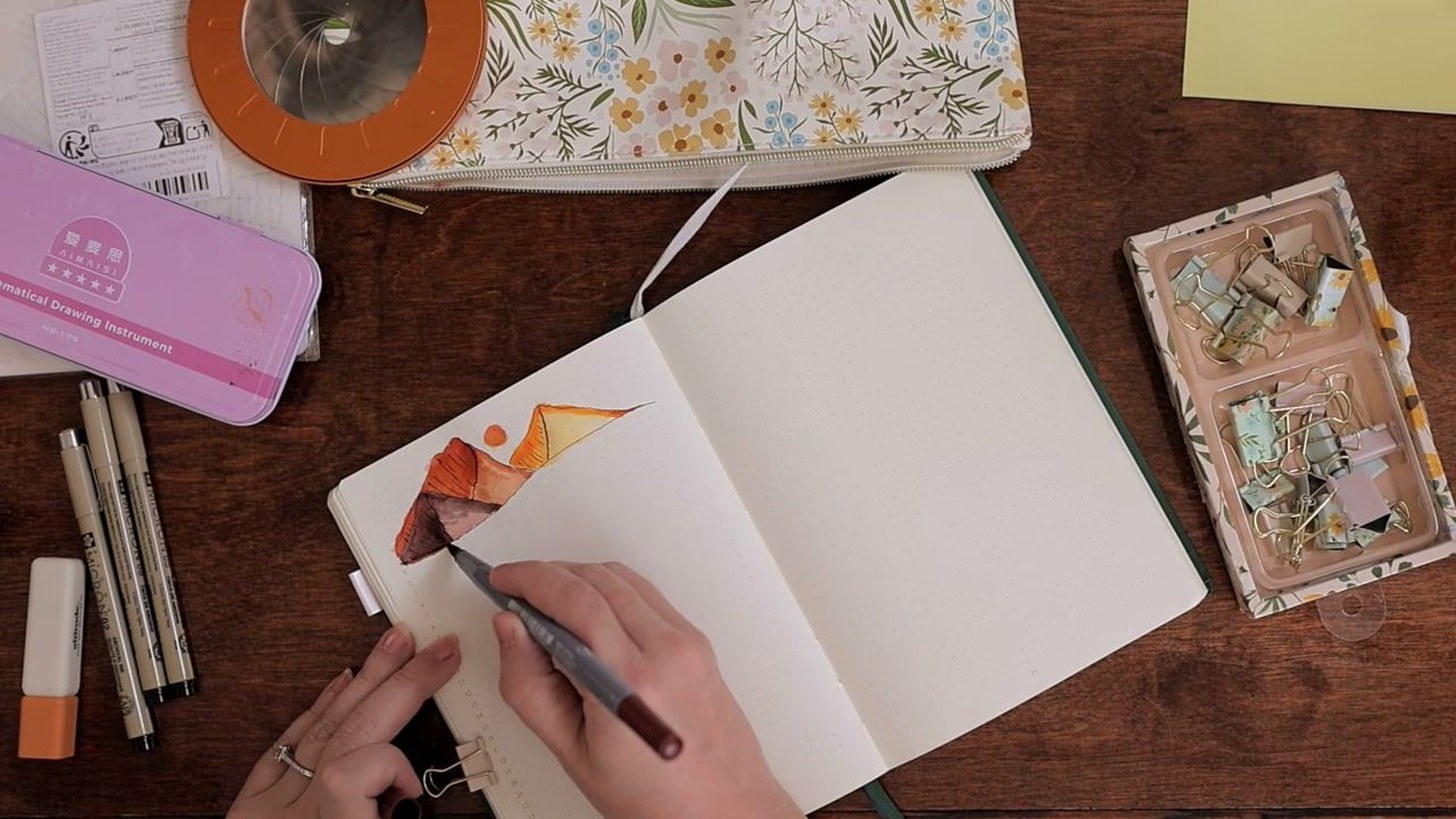
I did quite a bit of bullet journaling myself from 2019 to 2021. But to be perfectly honest, I never actually knew the bullet journal method.
I never knew how to use it as a productivity system. And I missed the most important part of the system entirely, which I think a lot of people do.
Where the bullet journal method came from
Recently I felt inspired to get back into bullet journaling. I was trying to figure out where to start and how I wanted to approach it this time.
Then I came across a book. I never knew there was a book that started this whole thing, but there is.
It's called The Bullet Journal Method, by Ryder Carroll. He's the inventor of the whole bullet journal system, and everything you hear about bullet journaling started with him.
He originally created it to help with his ADHD brain. He had trouble focusing and getting from point A to point B.
So he built a system that worked with his brain, and it caught on like wildfire.
I listened to the book in like a day. Within the first few chapters, I realized I had been missing the entire point.
The bullet journal was meant to be a thinking tool.
After using the method properly for the past month, I've found incredible increases in my efficiency and my focus. I've become more mindful and more reflective too.
For years, I'd wanted to do therapeutic journaling, but I never had an official journal for it. So I very rarely sat down to write anything.
Even when I did, it went into my scrap journal. Once I was done scribbling whatever to-do list of the day, those pages were done and that journal got trashed.
All you need is a pen and a notebook

My designs have been very minimal. I do have an artistic side, and some of my pages got a little artistic, but you don't have to.
Literally all you need is a pen and a journal to use the bullet journal method. A ruler is probably helpful, and a highlighter can be really nice.
Ryder Carroll describes it as a tool at the intersection of mindfulness, productivity, and intentionalism. It helps you slow down enough to decide what actually matters, and then organize your actions around that.
I've used tons of digital tools. It's been therapeutic and kind of soul-filling to pull back from all the information overload.
Literally any piece of technology has different tabs and things that can suck you in. The book even mentions that information overload today accounts for more loss of focus than smoking marijuana or exhaustion.
Getting back to the core of pen and paper and my own thoughts acts like a mental sanctuary. It gives me this nice, warm, cozy feeling just opening it up and going through my pages.
Why everything in one place matters
I love the simplicity of having everything in one place. I think that's one of the biggest upsells of a bullet journal over another planner, a digital to-do list, or even a paper one.
Having a spot for everything keeps you from having things scattered all over the place.
Before this past month, I had one big general notebook. I'd brainstorm ideas, write lists of things to do, and write chores other people needed to do.
Every thought I had was scattered throughout that notebook. It got things out of my brain and onto paper, which is great, but there was no sense of organization.
Once I was done with that day or that project, I never went back to what I'd written. With a bullet journal, you do go back.
You're constantly migrating unfinished tasks from one day to the next, and from one month to the next. You're constantly reevaluating what you did with your days.
In doing that, you're filtering through what's still important and what isn't. You're also seeing everything you've accomplished.
It's an amazing reflection and self-awareness tool. The notebook becomes a kind of source of truth in your life, which I think is really cool.

Rapid logging, the language of the bullet journal
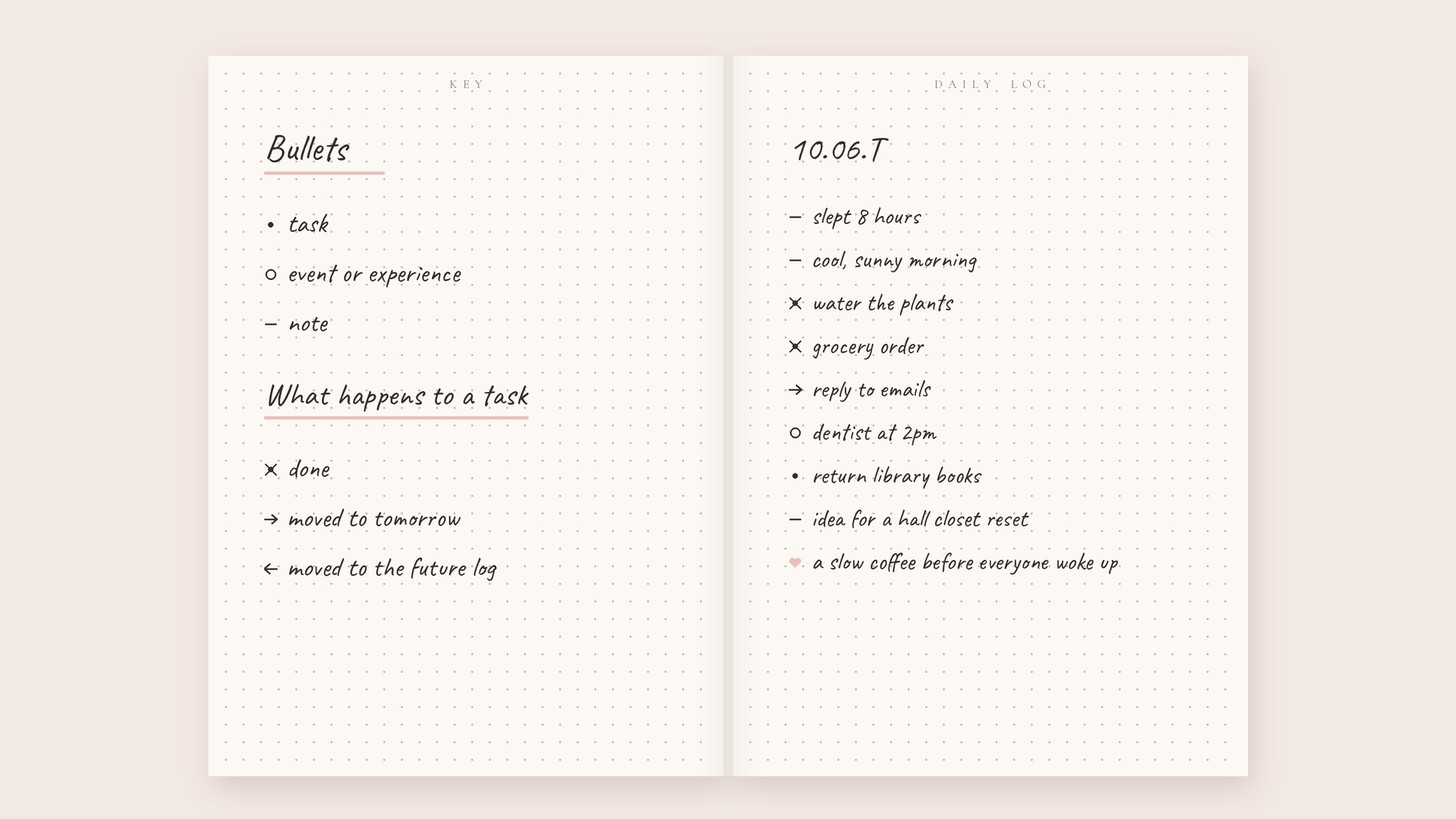
Before getting into spreads, it helps to learn the language of a bullet journal. I never learned about rapid logging before, and it's one of the core ideas behind the whole method.
Even if you're thinking, nope, I'm never going to bullet journal, that's fine. You can still use rapid logging in your daily note taking, and I've found it to be very efficient.
Instead of writing long sentences with all the details, you condense each thought into a short but still understandable bullet point. The bullet itself tells you what type of information it is.
It doesn't have to be in any order. If you're like me, you think of a task, then an event, then a random note you want to remember later, all in a row.
You can put it all on the paper as it hits your brain. The little symbol you use for each bullet is what tells them apart.
The three traditional bullets
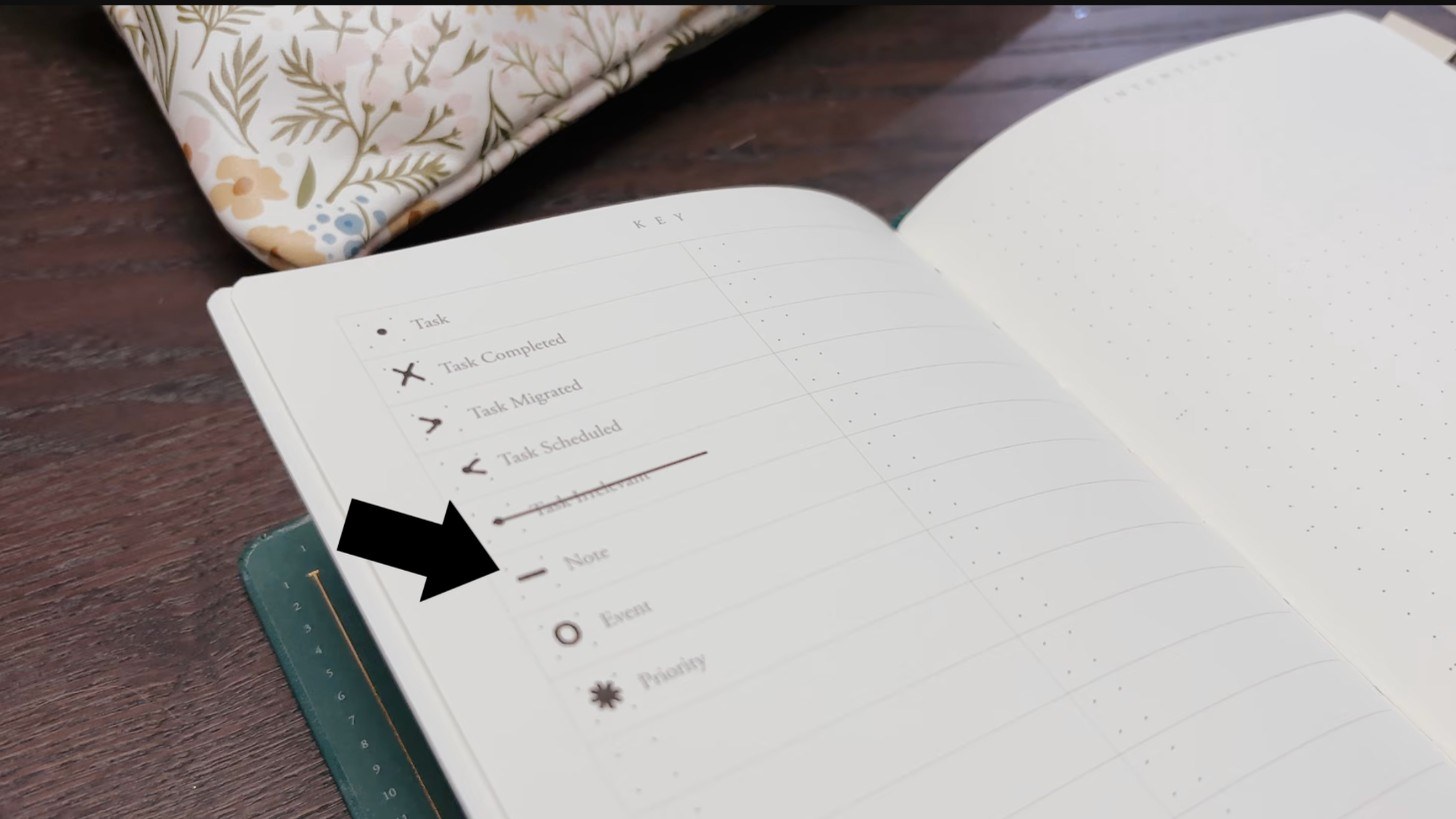
A small dot is a task. Keep it small, because you'll transform that dot depending on what happens to the task.
A circle is an event. I love that Ryder Carroll describes this as experiences, or things that have happened, which covers calendar events like a dentist appointment plus anything you live through.
A dash is a note, and you can have as many notes as you want. Skip the long formal punctuation and the details that don't matter.
The goal is to capture the key concept of a thought as succinctly as possible.
Later, when you look back on a month or a year, you can read through quickly. You get a bird's eye view of everything you experienced.
What happens to a task
Once you finish a task, put an X over the dot.
If you didn't quite finish it and you're moving it to tomorrow, turn it into an arrow pointing right, meaning forward in the journal. I do this all the time.
If it belongs to a future month, like you decide to put it off until next quarter, turn it into an arrow pointing left. Left means it goes back to the beginning of your book, where your future log lives.
Once you try it a couple of times, it sticks pretty fast. Dot, task. Circle, experience. Dash, note. Finished this one, X over the dot.
The four core spreads
There are four core spreads in a bullet journal. The index, the future log, the monthly log, and the daily log.
Those are really the only four that are highly recommended. Anything beyond that is considered a custom collection.
One of the awesome things about a bullet journal is its modular nature. Spreads don't have to exist in any consecutive order.
You can go back to a spread you made for the entire year, even months and months down the line.
The daily log
Out of every spread I've completed so far, the daily log is the most used, and the book says the same. It's really the heart of the bullet journal.
It's also the part you could do in any notebook. If you have lined paper right now and want to try the system, you can rapid log today with no art and no lines to draw.
You'll come back to it at least twice a day to update it. It keeps the functionality rolling and the reflective nature going, and it catalogs what life was like today.
Tasks, experiences, notes, random thoughts, things you want to remember. Everything goes in that day instead of bouncing between different lists and notebooks.
It ends up feeling like a combination of a task list and a running journal of your day.
And if you suddenly get the urge to work through some feelings in a classic therapeutic journaling format, you can do that right there too.
I'll just skip a space in the middle of my daily log and journal for a paragraph or two. I always get clarity when I do this, and then I skip a space and get right back to logging.
A look at two days in my daily log
A good example is March 6th and 7th. The 6th was a day I was feeling particularly tired and a little discombobulated, and I felt the need to process some stuff.
I write the month number, the day number, and the first letter of the weekday. So I wrote 03.06.F for Friday and started with notes right off the bat.
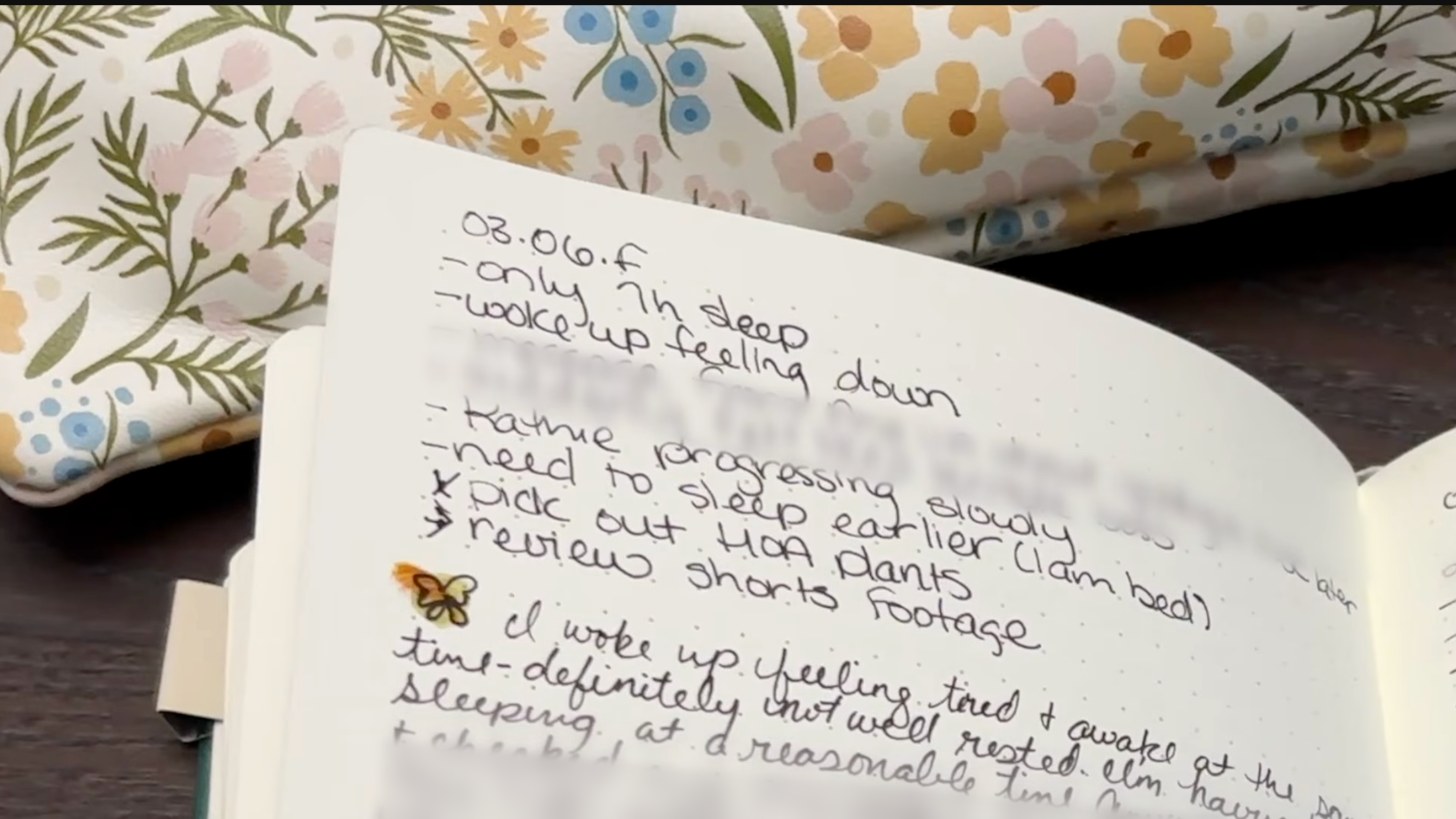
Dash, only seven hours of sleep. Dash, woke up feeling down. A few more dashes, including a note to myself that I need to go to bed earlier than 1 a.m.
Then I added a couple of tasks, picking out plants for the HOA and reviewing shorts footage for social media.
I put an X on the plants because I finished that one. The shorts got a right arrow because I moved them to the next day.
Then my handwriting changed from easy-to-read print to cursive, because I was in flow and writing for myself.
I wrote out feeling tired and awake at the same time, and not well rested. I wrote about feeling depleted, and overstimulated from having a toddler with me constantly, all day, every day.
When I was done, I skipped a space and added another task, Pinterest course. It all lives right there, because it all happened on the same day anyway.
The 7th was the day a close family member of ours passed away. Thank you all for the warm wishes and love from this community while I took the past two weeks off.
The first thing on that page is an experience. Kathy passed at 5:37 p.m.
That moment belongs to the circle bullet. It was an experience in my life, bigger than a note, and I was there when it happened.
I added little notes underneath. It was a positive setting, a bright day, and we told stories and shared laughter.
Even those few dashes were a therapeutic process for me. They're something I can go back to in the future to remember what that experience was like.
When I get to the end of the year thinking, man, I didn't accomplish anything, I can look through these pages.
I can see what my life was like on those days, and it doesn't take a lot of time.
Little notes of gratitude
I've also started adding little notes of gratitude. I put a little heart in my daily log and leave a note of what I'm grateful for.
The other day, I was grateful for Matt. When Chloe wakes up earlier than me, he often takes her to the restroom and gets her an oatmeal bar and some milk while he's getting ready for work.
He sets her up with something to do so I can get another hour or two of sleep. It's so helpful for me.
Yesterday, I wrote that I'm grateful we have Matt's parents, who can occasionally give us a little break with childcare.
A lot of my gratitude right now is toward help with the toddler, because of the stage of life we're in. But it's going to go by fast.
If the daily log is all you do, with rapid logging and the occasional therapeutic entry, you're going to find so much more clarity. I have found so much more clarity and emotional ease.
My ideas and thoughts are saved, so I'm not searching for them and losing them. It feels safe, and it feels simple.
When I want to work through something heavier, it's become my go-to way to declutter my emotions and process what's weighing on me.
Why writing by hand helps you think
One benefit discussed in the book is the impact of handwriting on thinking. I loved listening to this part, because I can feel it when I put pen to paper.
Writing by hand activates multiple areas of the brain at once. It's slower than typing, so you're forced to process information more carefully.
You have to put it in your own words instead of parroting something you're seeing or something somebody else is saying.
Handwriting helps shape your thoughts while you're recording them.
That's part of why journaling has long been used in therapeutic settings. Writing creates a bridge between thinking and feeling that other tools skip.
Those extra steps help you remember and process things. You draw your own ties and connections between different thoughts.
That's how you become more creative and come up with better, newer ideas. Some of those connections may never have happened if you hadn't written them down.
I love this system because it's simple and efficient, and it evolves with whatever season of life you're in. If life changes, the journal changes too.
Right now, it's where I capture tasks and reflect on my days. It's where I track important patterns and experiences, and organize my work without needing multiple systems.
The future log
The future log is another core spread, and it's really basic. I made some back in 2019 and 2020 before I even knew they were called future logs, just pages showing all the months of the year.
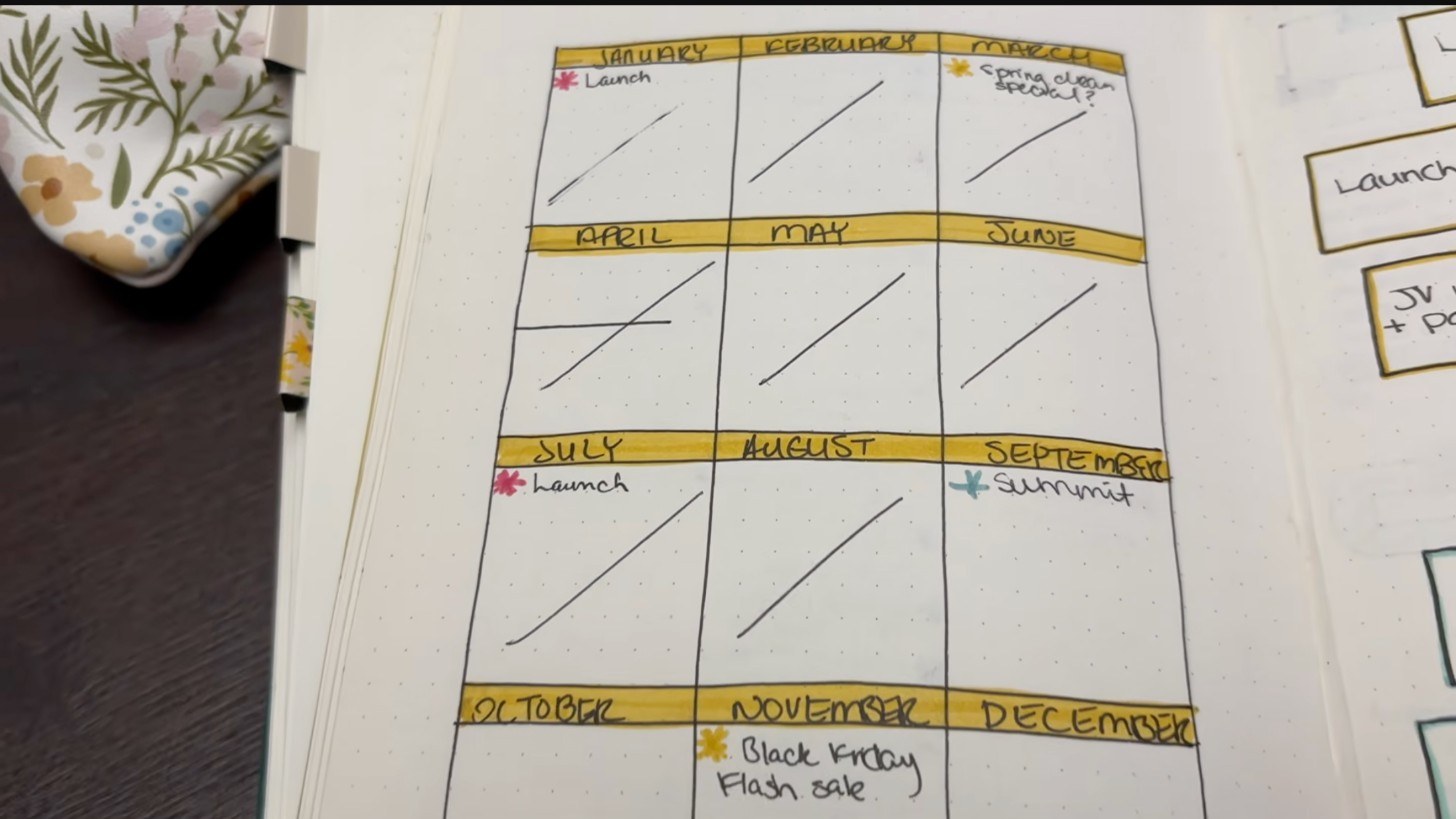
It's a holding space for everything that needs to happen later in the year. Appointments, travel, projects, tasks, and events that are too far away to worry about yet.
Instead of keeping all of that in your head, or rewriting it every day, it parks in the right month. You know you won't be working on it tomorrow, so it waits there until that time arrives.
When that month comes, part of reviewing and migrating is checking the future log. You move those items over to your monthly log.
Anything that needs to go further out gets an arrow and a new spot in a later month, and you're done. You don't have to think about where things go, because the process just keeps things moving.
The monthly log
The monthly log is a place to track what you completed each day of the month, in shorthand. Big calendar spreads with priorities and goals would be custom collections, which I also have.
The standard way is to list one through 31 down the left page, or however many days are in that month. On the right page, list the tasks you expect to do that month.
I have home tasks and work tasks, so I made a separate column for each. I did a little artwork on this one because I saw something that inspired me during my research.
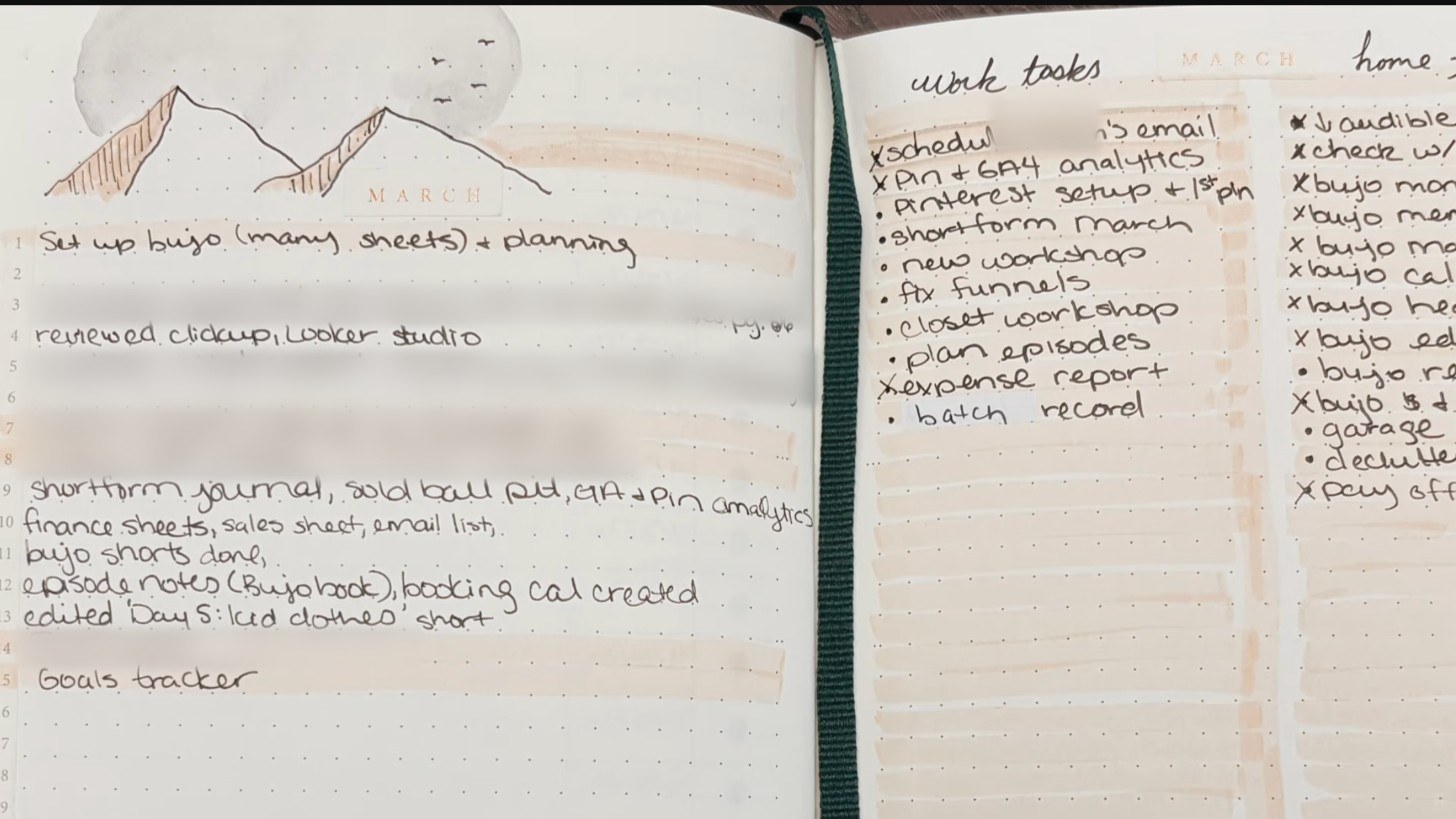
Drawing the spread can get as detailed as you want, but actually using it takes me seconds. I put an X over what I completed, then write it in shorthand next to that day on the left.
On the first of March, I wrote "set up Bujo, many sheets and planning." My work column has things like schedule an email and look at Pinterest and Google Analytics.
It's just dot, task, dot, task. As I complete them, I come back, put an X on the dot, and make sure it's logged on the left.
At the end of the month or quarter, I can scan this page and see how I spent my time.
I can ask myself whether it was a good way to spend my time, whether it paid off, and whether it made me happy.
At the very least, I can see that I did stuff. We forget so much of what we accomplish every day, and this is a great way to get some truth behind it.
The index
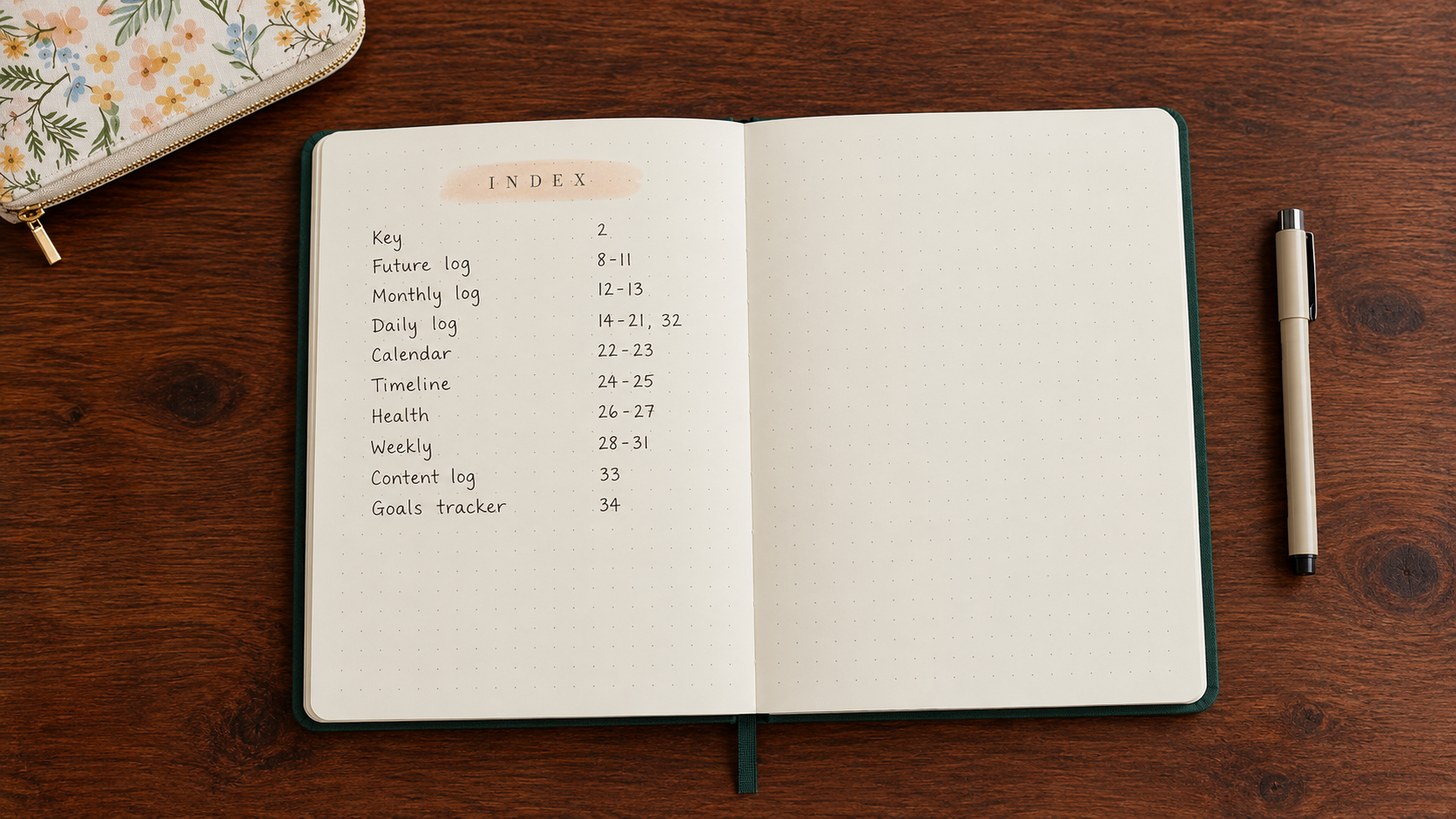
The index is pretty self-explanatory. You write what the spread is and where it lives, like future log, 8-11.
It's okay if pages aren't consecutive. Just add a comma and the next page where it picks up, so you can jump to any module without flipping through the whole journal.
Custom collections I've added
Everything beyond the four core spreads is a custom collection. It's optional and based on you and your needs.
You could have a custom collection listing your medications and logging your blood pressure. You could have an editorial or content calendar, which I do.
A minimalist calendar
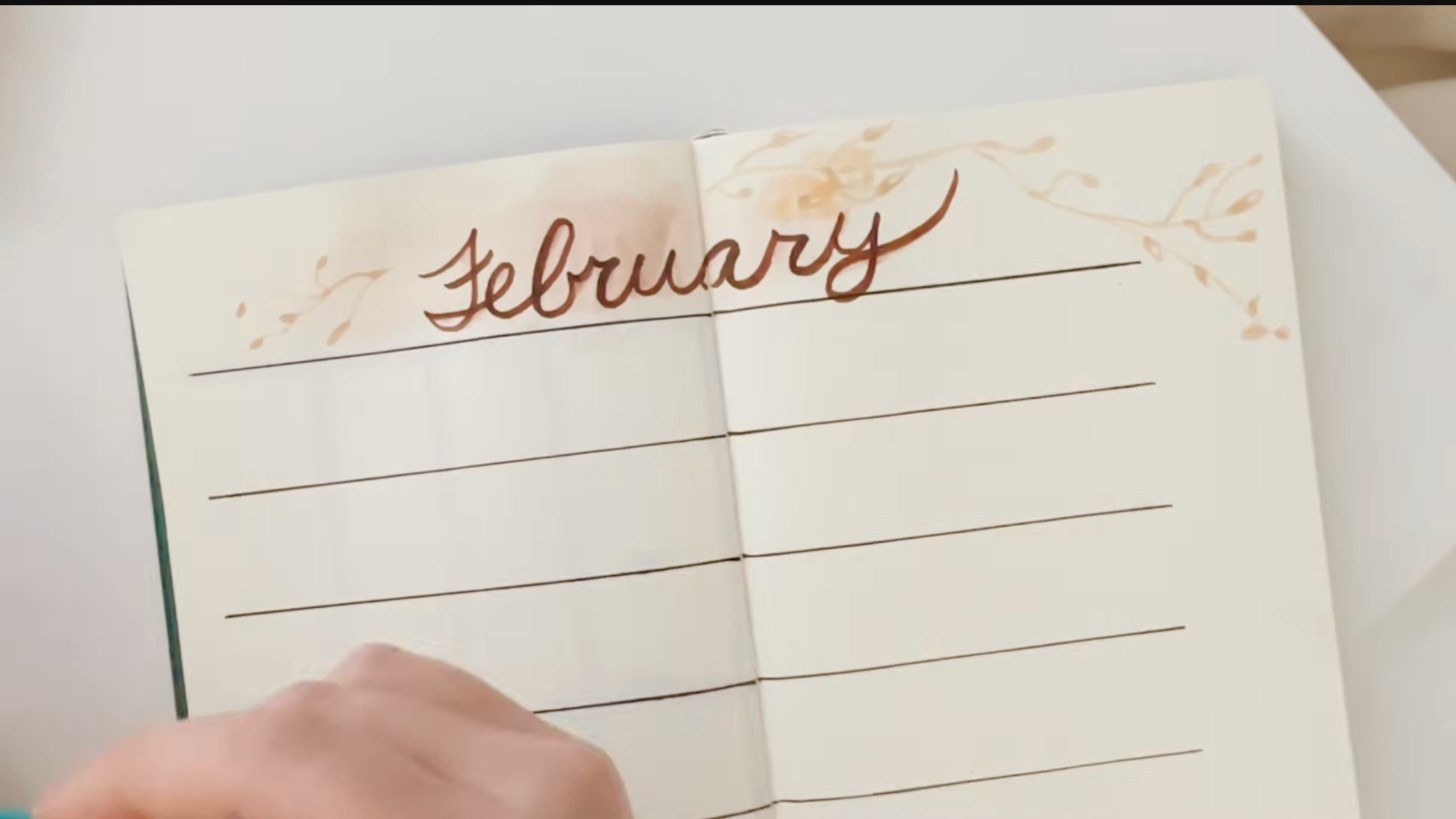
One custom collection I made is a simple minimalist calendar. I didn't even draw vertical lines.
I used a ruler to draw six evenly spaced horizontal lines across two pages, then evenly spaced the date numbers. For March, I just wrote March really big in cursive at the top.
At the bottom, I wrote the two projects I intended to focus on that month. In February, I got a little more creative and drew some little flowers while I practiced blending with my watercolor pens.
A monthly timeline
Another visual I wanted was a monthly timeline. On the left page, I drew a little replica of February's calendar and listed one through 28.
Anything going on that day got a dash and the event. This one is for events only.
I had February's timeline on the left and March's on the right, because something lasting four weeks started at the end of February. So I listed weeks one through four in staggered boxes going down.
When other events overlapped, I drew bigger brackets around the intersecting dates.
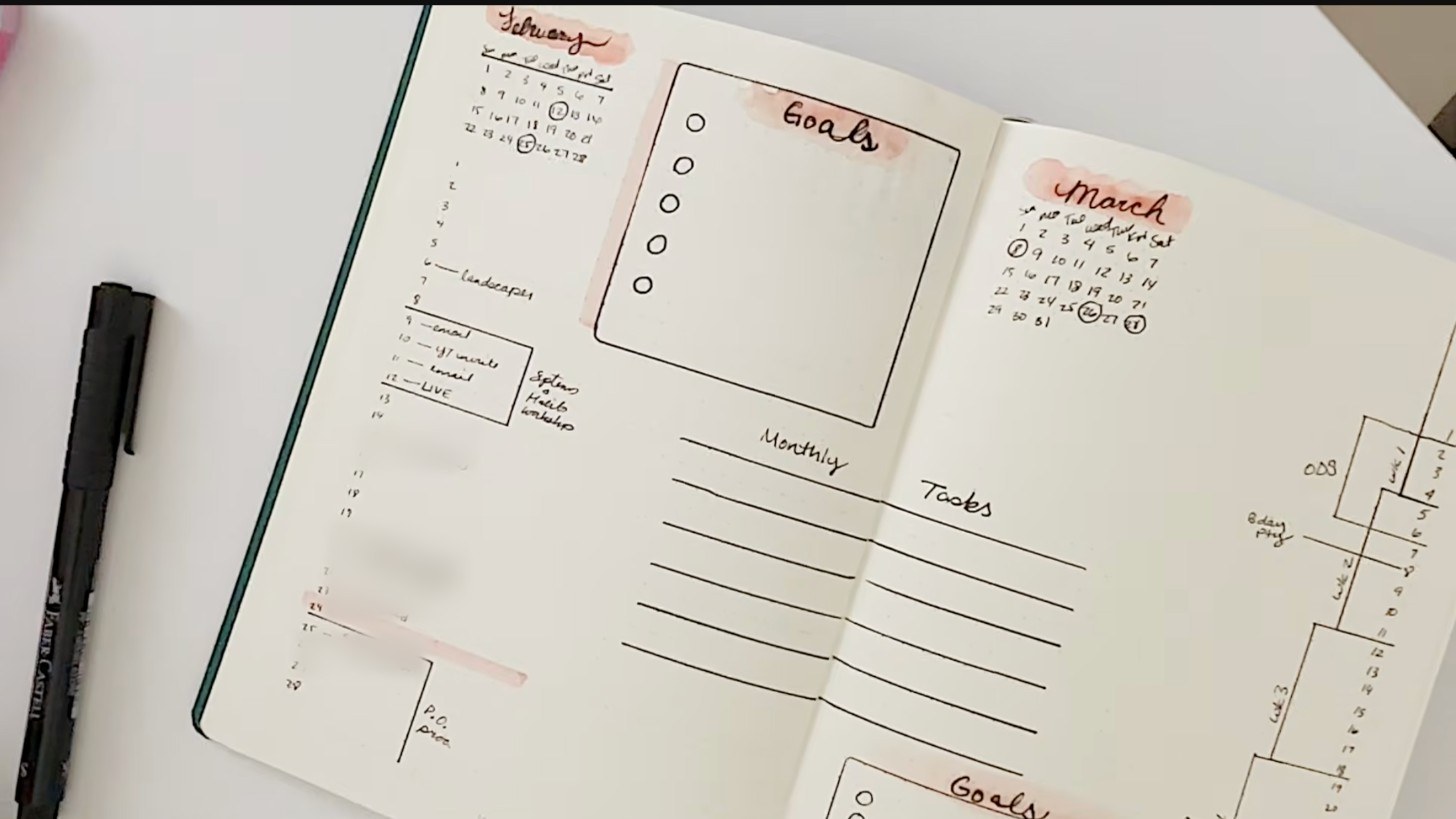
In February, I ran a little promotion for my systems and habits workshop from the 9th through the 12th.
An email on the 9th, a YouTube invite on the 10th, another email on the 11th, and we were live on the 12th.
I bracketed those four dates, added a dash for what I did each day, and wrote "systems and habits workshop" outside the bracket.
You may not know what all the brackets mean, but they mean something to me, which is all that matters.
At a quick glance, I can see how many things are layered on top of each other in a given week, so I can budget my time. It's more of a cool-to-have than an I-need-this.
A health spread
I also made a two-page health spread, and I got a little more artistic with it than you need to. On the left, I'm tracking my cycle and my headaches.
I'm pretty sure I'm going through perimenopause, and I've started getting migraines that have become more frequent. My cycle is starting to fluctuate too, so I want to see how often each is happening.
I drew a circular graph divided into 31 segments, one for each day of March, with room to use it for April too.
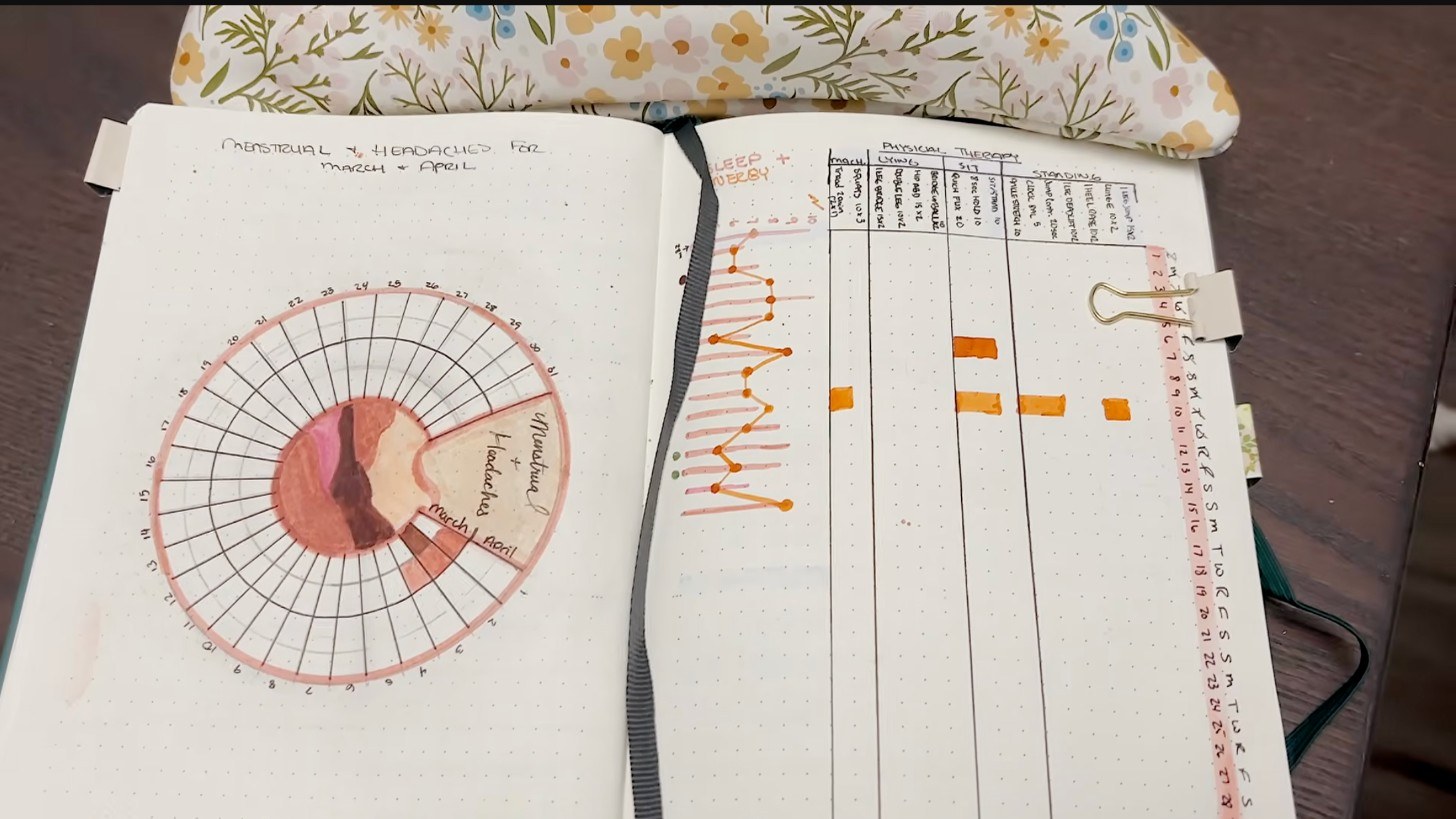
I highlight a segment light pink when I'm on my period, and a brownish color underneath when I have a headache. At the end of these two months, I can see exactly where the dark spots and light spots land.
On the right, I'm tracking sleep and energy. A light pink bar runs from four to 10 for how many hours of sleep I got.
An orange dot marks how energetic I feel that day, and I connect it to the next day's dot. The orange energy line overlaps the sleep bars, so I get a visual of whether more sleep means more energy.
Or whether a full week of not-so-great sleep makes my energy lag for a week or so after that.
On that same page, I have all my physical therapy exercises, divided into standing, sitting, lying, and machines. There's a lot I still need to do for the ankle I fractured a couple of years back.
I list the dates one through 31 in a grid and mark the exercises I did each day with an orange marker. It encourages me to stay regular and shows me which ones I need to focus on more.
You may not need a health spread at all. Or you might track very different things, in a very different visual way, or with plain headlines and lists.
It's very tailored, which is one of the things I love and find so fulfilling about this type of journaling. And it all sits in the same place as my therapeutic journaling, my daily log, and my future log.
Weekly planning spreads
I tried three different weekly spreads before I found one I really liked. First, each week spanned two pages, with Monday through Wednesday on one and Thursday through Sunday on the other.
I didn't love that, and I found I wasn't really using it. So the next week, I put all seven days on one page, and I liked that better.
I like things to be succinct, so I can see everything at a glance without spreading my gaze around too much.
Now I list Sunday through Saturday down the middle of the left page. Scheduled events go to the left of the dates, and dots for tasks I hope to complete that day go to the right.
On the right page, I drew a little calendar with this week highlighted in orange. Below it are three blue highlighted lines for my priorities that week.
There's a little habit tracking section for meditation, journaling, outdoors, movement, and smoothie intake. Each one just has seven circles next to it.
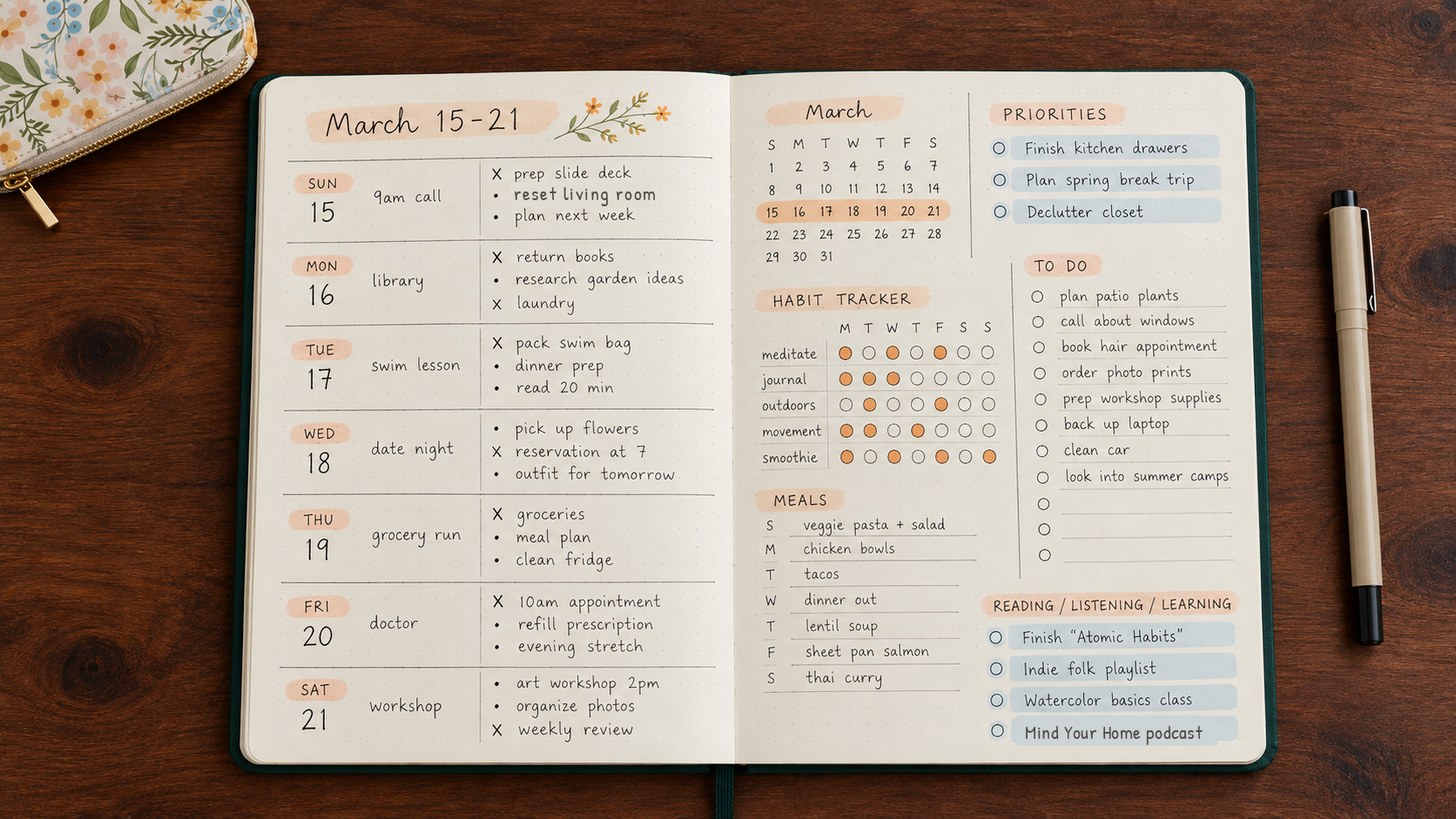
Below that, I have pen-drawn lines for meals and dinners. Meal planning is one thing that can sometimes fall through the cracks, so I'm trying to get ahead of it.
There's also a section for what I'm currently reading, listening to, and learning, with four highlighted lines.
The rest of the page is a big space for to-dos and notes that aren't assigned to any day. It has the most real estate, so I can jot things down as they come to mind.
I made all of this with a ruler and a highlighter, and it didn't take long at all. Even so, the weekly spreads have been the least used for me, and I'm not 100% sure I'll keep using them.
A content log
I also have an editorial or content calendar. It's really more of a log, because it isn't in a calendar shape.
It covers all of March and April, with columns for type, release date, topic, and notes. A pink dot marks a YouTube or podcast episode, and a brown circle marks social media or shorts.
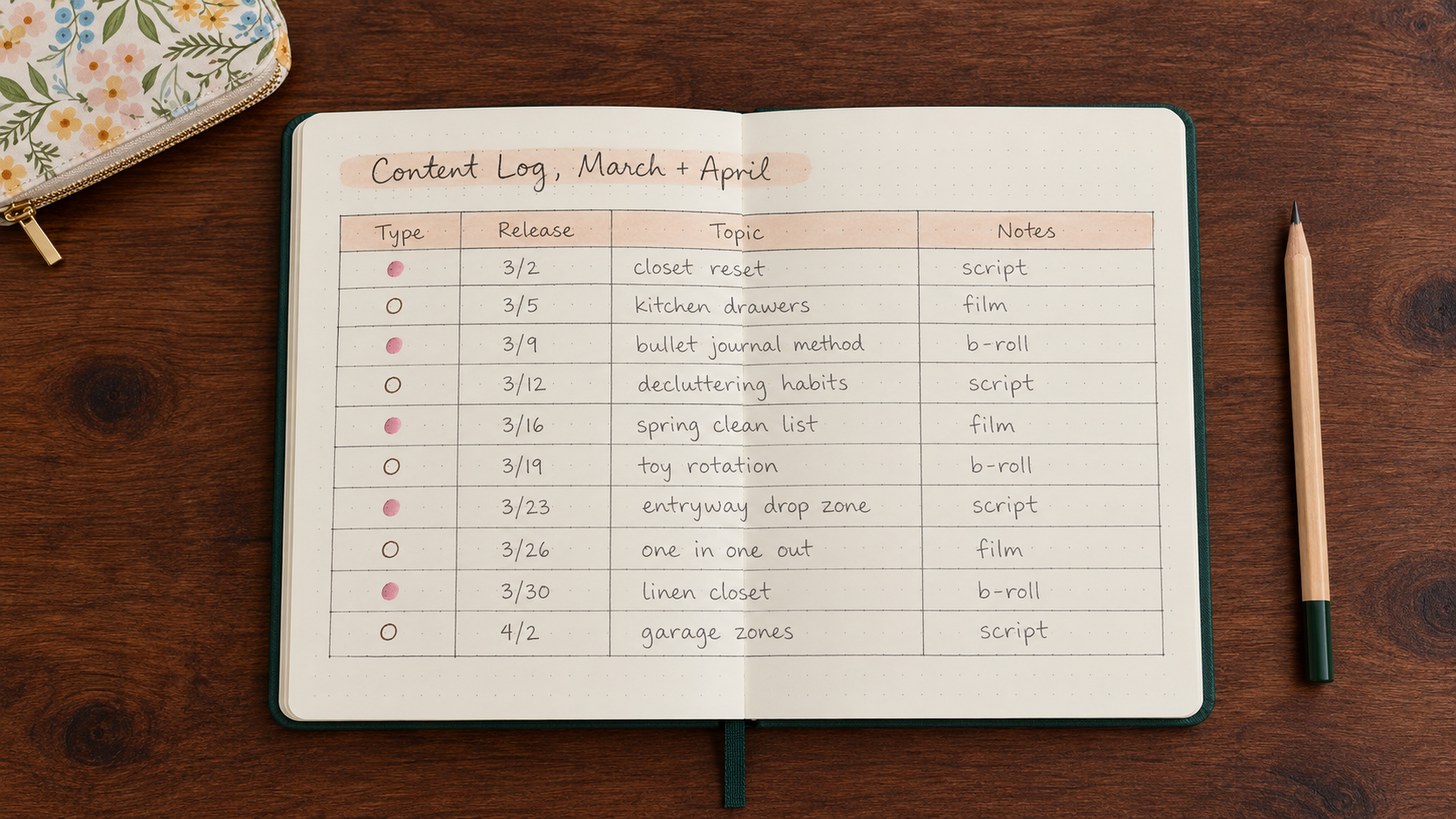
I write it in pencil, because I change my mind all the time on the content I'm going to release. It gives me a place to brainstorm and make little notes for my scripting and planning.
A goals tracker
The last thing I created is a goals tracker. I had to journal about it first, what my goals are and what I feel is worthy of tracking.
With my business, it always comes down to growth and revenue. So I drew another circle graph, like my cycle and headache graph, divided into 12 sections with a pretty little picture in the center.
The top six sections represent growth sources like Pinterest, YouTube, and collabs. The bottom six represent revenue sources.
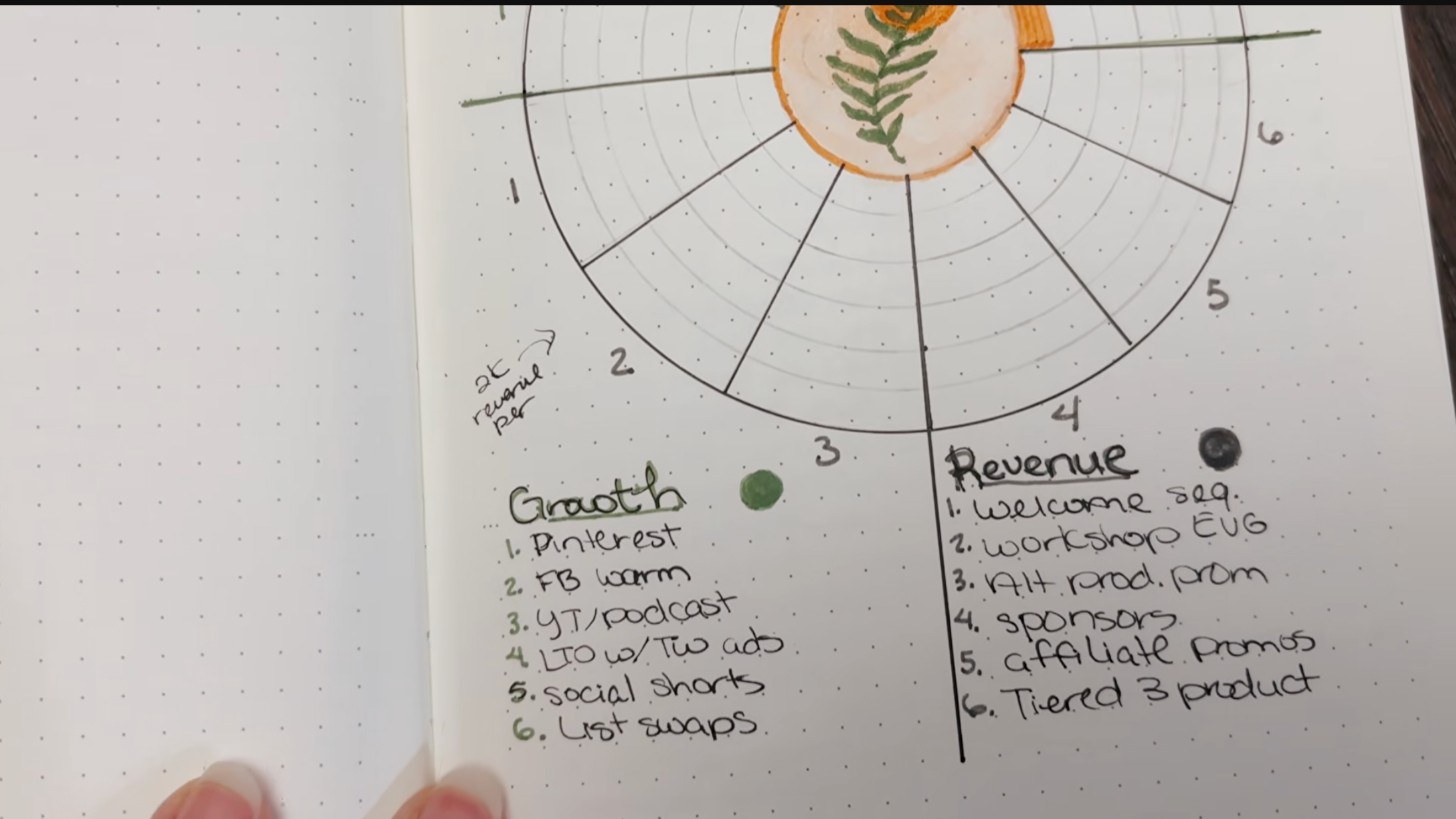
Each section has smaller rings inside that represent progress toward specific numbers. One ring might be 350 leads or $2,000 in revenue, and the next ring out is another 350 leads or another $2,000.
As my goals progress, the sections slowly fill in. I'll be able to see which sources are driving most of the growth and revenue.
Drawing it was not simple. But filling it in and maintaining it all year is just verifying a number and coloring in a segment.
Spreads I still want to add
I want to add a learning, reading, and listening log to track everything for the year.
Maybe also running lists of books I want to read, podcasts and audiobooks I want to listen to, and courses or skills I want to learn.
And maybe a simple finance tracker, nothing too deep. I'm doing a six-month no spend challenge that I started at the beginning of February.
It would be cool to log how much I spent each week, or which areas I didn't spend in at all.
If a big project, promotion, or collaboration with a lot of moving parts comes up, I might create a custom collection just for that. It's a simple way to visualize movement toward bigger targets.

The heart of the bullet journal method
Honestly, you could skip most of the spreads I shared today. I wanted to show the possibilities, and how you can tailor this system to your life without needing any art skills.
Once you create a spread, filling it in is so simple and quick on a daily basis, especially with rapid logging. Sometimes I even miss the art of creating them.
A lot of people see the beautiful calligraphy and watercolor spreads and think, well, I'm not an artist. That bypasses the whole core concept of what a bullet journal was created for.
It's a thinking tool. Everything lives in one place, in a modular system, so you can reflect from day to day on what deserves your attention and how to move toward your actual goals.
That way you're not wasting your time on things that are just burning your energy.
It's the habit of pausing long enough to decide what deserves your attention, and what you'll keep putting your effort into.
That habit fits right into simplifying your home and life so your energy goes where it counts.
I've been really nerding out on this. I was so excited to share it, because I've felt such a huge relief in my own life using the official bullet journal method.