Clutter Is a Trauma Symptom

There is a side of clutter that almost nobody talks about, and it has nothing to do with motivation, willpower, or the right decluttering checklist.
For years, the conversation in this space has been almost entirely one-directional. Clutter causes anxiety, clutter causes depression, clutter drains your energy.
And all of that is true. But it is not the whole picture.
Because for a lot of people, the problem came first and the clutter followed.
That is what this conversation is really about.
The Lens I Come From
I want to be upfront about something before diving in. Most people who talk about minimalism and decluttering, myself included, come at it from a specific angle.
We were never really the clutterers. We grew up around clutter, or we got to a point in life where things piled up, and we found our way out.
And that shapes what we teach.
For me, it is a second-generational lens. My mom grew up in an abusive household where she was not allowed to buy her own clothes.
She got pregnant with me at 17 so she could get out and live on her own. For years, we lived off different versions of potatoes while she worked as a grocery bagger.
She eventually went back to college as an adult, and I still remember helping her study John Donne while I was just a kid.
She pulled herself up from nothing. And because of that, letting go of things, especially clothing or items passed down from family, was always physically uncomfortable for her.
Her body learned, at a deep level, that losing things was not safe.
I can see that now in a way I could not when I was younger. And it changed how I think about clutter entirely.
Why Clutter Is Not Just Clutter
When someone grows up in scarcity, or loses everything suddenly, or lives through an experience where their belongings were taken away without consent, the body remembers that. And the response to letting go of items becomes tied to survival instincts that have nothing to do with the item itself.
Two comments from a video I released about what psychologists know about clutter have stayed with me for years. One person wrote that when they were 15, after their mother was killed, their father told them they were moving 3,000 miles away the next morning.
Just pack a change of clothes. A moving company would handle everything.
There was no moving company. They lost every single thing they owned.
That comment got 1,200 likes. Another, with 452 likes, described two reasons for their clutter.
One was the trauma of an abusive childhood, where the clutter is a protective barrier. The other was a parent who removed toys without permission, which meant they never learned a healthy decision-making process around letting go.
As they put it, taking away a much-loved toy gives a child grief. And grief creates an aversion to releasing things.
Those comments represent thousands more people who felt exactly the same way but did not type it out.
So when someone cannot let go of their stuff, the root is often the nervous system.
What Nervous System Dysregulation Actually Means
Dysregulation sounds clinical, but the concept is simple. Your nervous system has decided, usually below conscious awareness, that something is dangerous.
And it starts allocating resources toward survival.
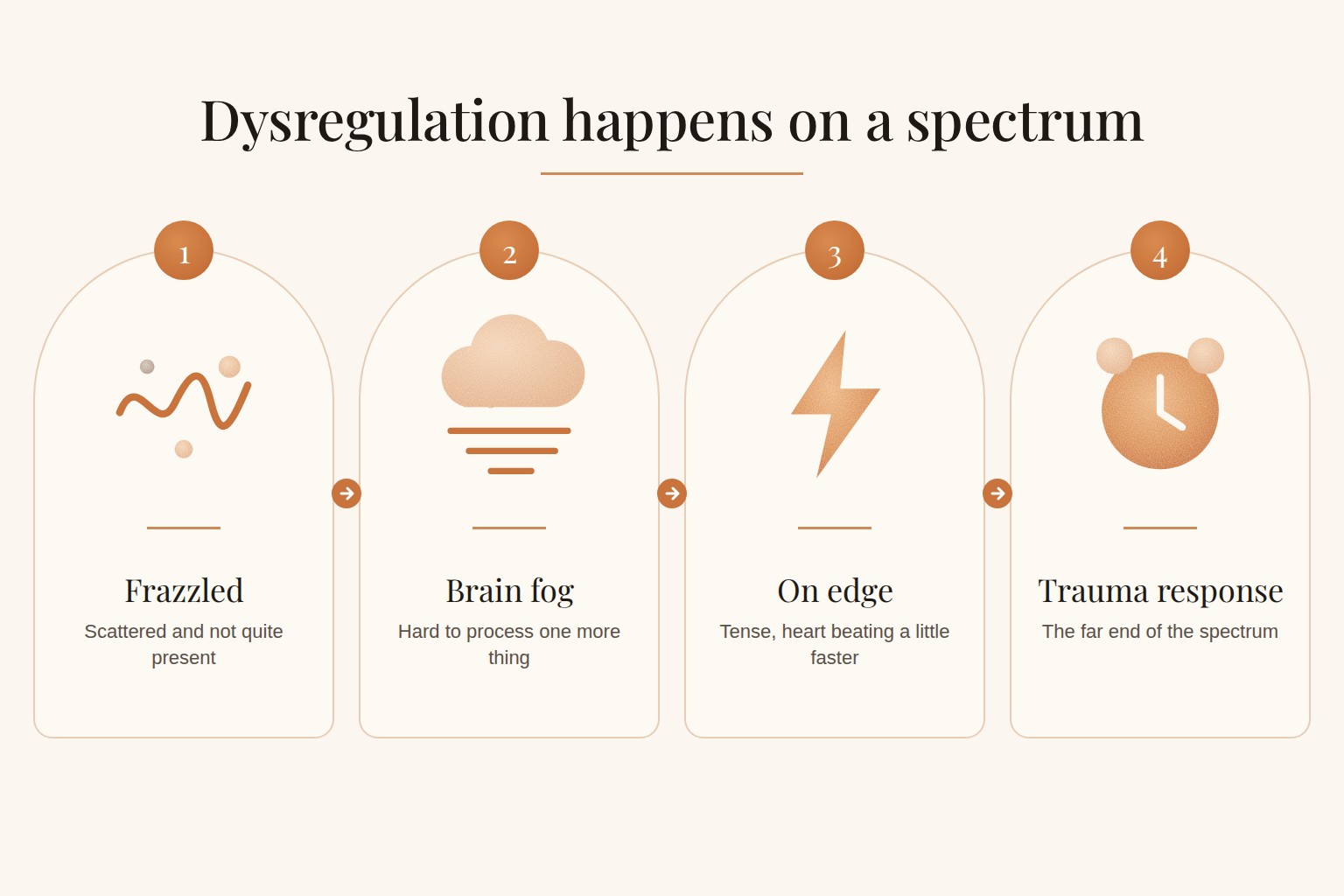
This happens on a spectrum. At the extreme end, it looks like a full trauma response.
But it can also look like brain fog, an inability to focus, feeling frazzled, and not quite present. It can feel like your nerves are on edge, your heart is beating a little faster, and you just need to walk away from the conversation you are having because you cannot process one more thing.
Decluttering asks a lot of your nervous system on a good day. There are micro-decisions stacked on top of micro-decisions, especially when you are working through a whole room or a closet.
If your nervous system is already allocating resources toward a perceived threat, it has nothing left to give to executive function. You are not being lazy.
Your brain is truly not available for that task right now.
And when the perceived threat is the clutter itself, or the act of letting go, it compounds.
The Shell of False Security
Clutter, in many cases, is performing a job. It is acting as a shell.
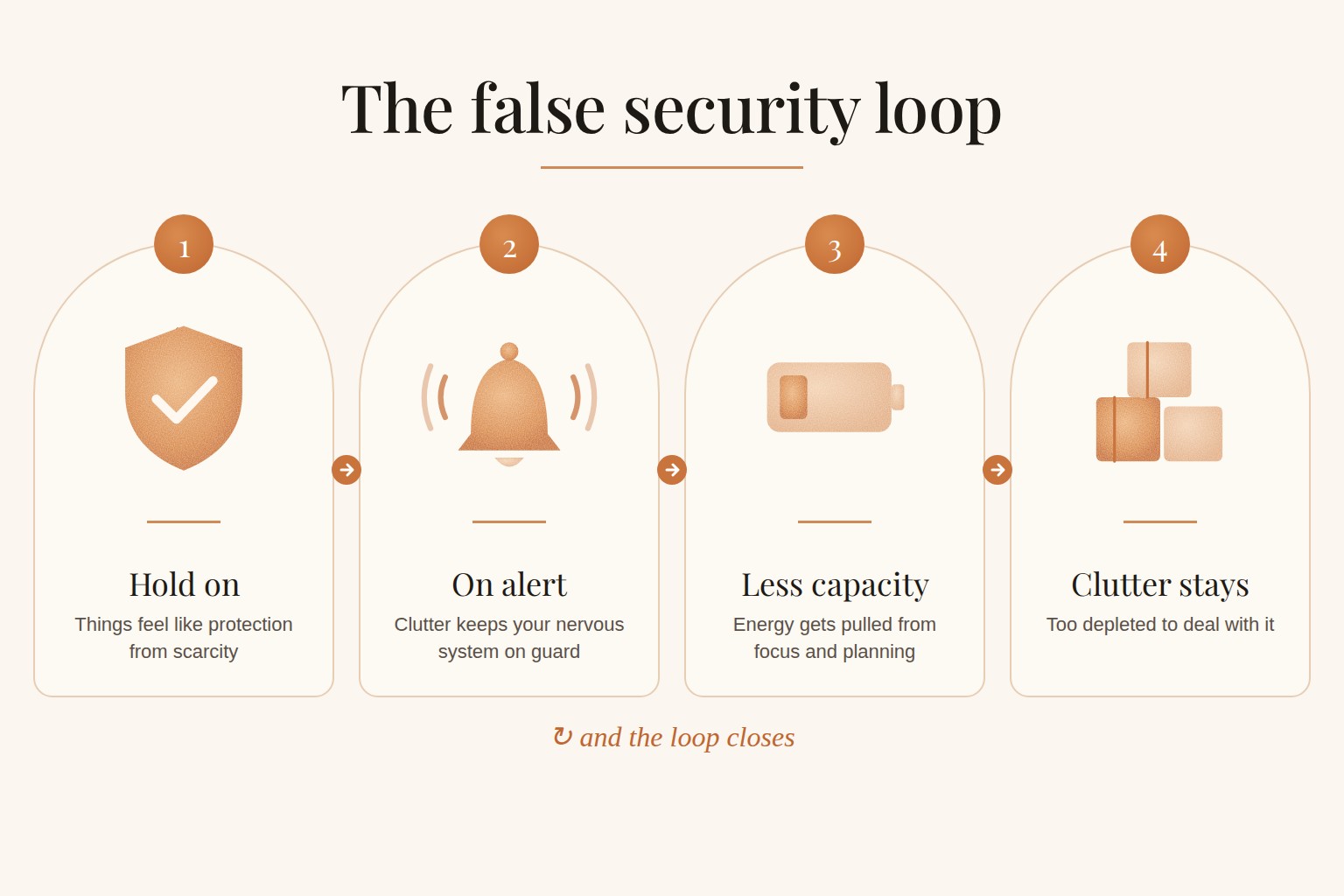
As long as you have all of these things, the scarcity mindset cannot grab you. You do not have to ask yourself what happens if you need this someday, or how you will handle whatever uncertain future you are afraid of.
You do not have to set a hard boundary between what you keep and what you release, because there is no black-and-white line when everything feels like it could matter.
It is like eating a candy bar. There is nothing wrong with that.
But when it becomes 50 candy bars, it is self-sabotage. And the same is true of the things we hold onto when every single item gets reclassified as part of the security blanket.
The painful irony is that the clutter providing that false sense of safety then becomes its own source of dysregulation. The environment you surround yourself with to feel secure is now keeping your nervous system in alert mode, pulling resources away from the very executive function you need to address it.
It is a closed loop.
Information Hoarding Is Part of the Loop Too
One pattern that shows up in people who are stuck in this cycle is what I call information hoarding. Constantly collecting articles, watching videos, downloading checklists, and consuming content about decluttering without actually doing the decluttering.
That is not laziness either. Researching and planning feel productive.
It gives you the sensation of movement without requiring you to open the closet and feel the things that opening the closet brings up. The root issue stays untouched.
And so the information hoarding continues, and nothing really changes.
How to Start Moving Through It
Before you push through decluttering while you are dysregulated, re-regulate first. Then move one step forward.
Regulation looks different for everyone, but a few things work well. Breathwork, even simple focused breathing, is incredibly effective.
Meditation, even a few minutes of resting your attention on your breath, is not a weird practice reserved for a specific type of person. It is a nervous system tool, and the more consistently you use it, the more accessible it becomes.
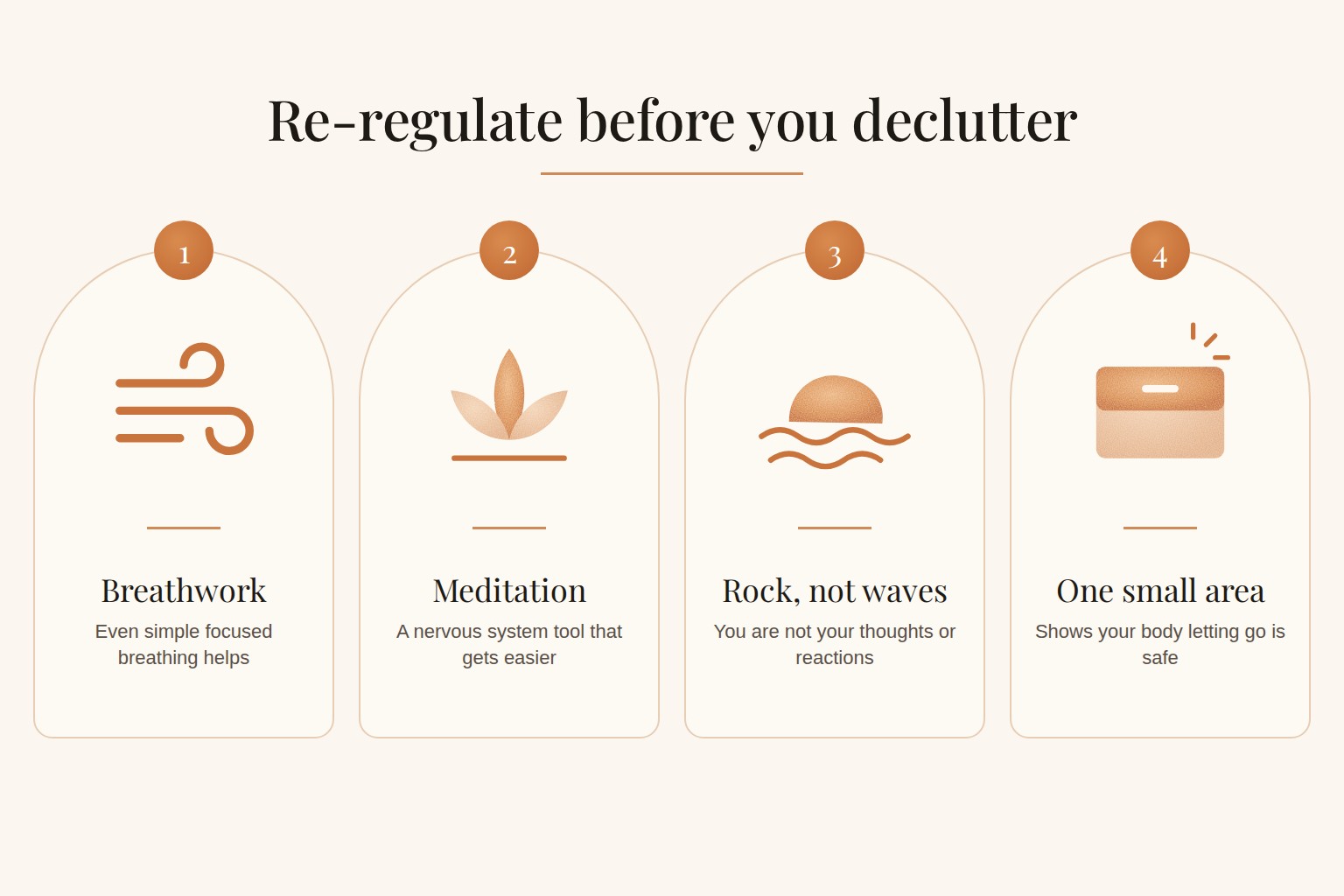
One concept I come back to often is that you are the rock, not the waves. The emotions, memories, and nervous system responses are crashing into you.
But you are not them. You are the being who is having those thoughts, not the thoughts themselves.
Practicing that separation, even just by saying out loud what you are feeling and why, creates a little bit of space between the reaction and the decision.
When it comes to your space specifically, gaining agency over one small area is one of the most practical ways to re-regulate. One drawer won't change your whole home.
It does prove something to your nervous system. It proves that you can do it, that it is safe to do it, and that letting go of something does not result in loss.
That evidence builds.
Struggle Does Not Equal Defeat
Something can be truly harder for you than it is for another person, for reasons that have everything to do with your history and your biology, and that does not mean it cannot be done.
The people who roll their eyes at words like nervous system or trauma tend to be the people who have never had to use breathwork as a lifeline. The people who have tried those tools and kept using them are the ones who needed them badly enough to find out they actually work.
If any of this conversation has felt like a mirror, start small. Pick the one section of your home that feels attainable, not inspiring, just attainable.
Do that one thing. And notice what it feels like on the other side.
That is where it starts.