Closet Full but Nothing to Wear? You're Using Your Closet Wrong
Most people are using their wardrobe closets wrong. And by wrong, I mean not in the most optimal way.
You'll know this is you if your closet is full, but you still reach for the same few outfits on repeat. And somehow you still feel like you have nothing to wear.
Or getting dressed takes way more energy than it should. All those small decisions, from accessories to which socks to wear to what shirt goes with the pants, just stall your morning.
Everything kind of feels mixed together. The things you never wear sit right next to the things you just bought.
Then there are the things from a previous version of yourself that aren't comfortable and you don't reach for. It's all mixed in together.
You can't find what you're looking for, or you forget what you even have. It's like the closet just swallows all of these things and you're constantly losing them.
Your closet is a system
Most people treat their closets like storage. And you might be thinking, "Well, yeah, that's what a closet is."
If you asked most people what a closet is for, they'd probably say storage. But your wardrobe closet in particular is actually one of the most used systems in your home.

So I want to encourage you to flow with me on this one. Expand your concept of what your closet is and what it could be.
Your wardrobe is a decision-making space.
It's where you're making choices, usually first thing in the morning when your energy is already really limited. And it's one of the first interactions most people have with their environment every single day, on repeat.
So when it's not set up well, when it's not functional and supportive, it creates decision fatigue right away. Immediately, you're using more energy than you need to just to get dressed.
Now your closet is a potential source of energy leakage. So we've got decision fatigue, and we have this regular source of energy leakage.
What you wear changes how you feel
Beyond all of the little frustrations and stress, there's also an identity piece. And it's especially powerful when we're talking about your wardrobe.
It's the most uncanny thing. What you put on your body can immediately change the way you feel and the energy and vibes you're bringing, even to yourself.
That's true even when you're not around other people, and we all know it. They say dress for success, or get dressed up if you want to feel better.
If you feel like you're in sloppy clothes constantly and you're just not doing anything with yourself, it makes you feel lower energy. It brings down your vibes.
And there's dressing as the identity you really want to step into, even if you're not that person yet. It's been proven that putting the right clothes on your body is as powerful as any other kind of mindset work.
That includes everything from affirmations to reading books to studying. Literally putting the things on your body is a real identity factor, and it helps these things fall into place.
If what we wore was purely functional, we'd all wear the same things. There'd be no reason for any kind of variety.
We wouldn't have the joy and excitement, or the shopping tendencies and shopping problems, that we have today. The clothes we put on our bodies really do speak to our identity.
So when your closet is full of things that don't quite fit or don't really feel like you anymore, there's a disconnect. Maybe you're keeping them because they're still fine clothes.
That's where the feeling of having nothing to wear comes from, even when you have plenty of clothes in your closet.
You end up with decision fatigue and this low-level stress. You feel not quite put together, even if everything technically fits inside that space.
3 reasons most closets don't work
1. Too many options
This one obviously relates to decision fatigue. Maybe you do have a closet full of clothes that actually fit you.
Now you have this vast number of options to choose from. You're deciding which items to wear and which items to pair with other items, and there's even more to sift through.
2. No structure
No structure leads to visual overwhelm and the whole stress of having to search for things. It's like the lost keys syndrome.
There's something particularly stressful and frustrating about not being able to find something. And it really doesn't matter what it is.
It could be something very minor that you don't even need right now, like a nail file when you don't have a hangnail. But if you can't find it, all of a sudden that's all you can think about.
You start wondering where this thing is and why you're constantly losing stuff. It kind of takes over the focus of your brain.
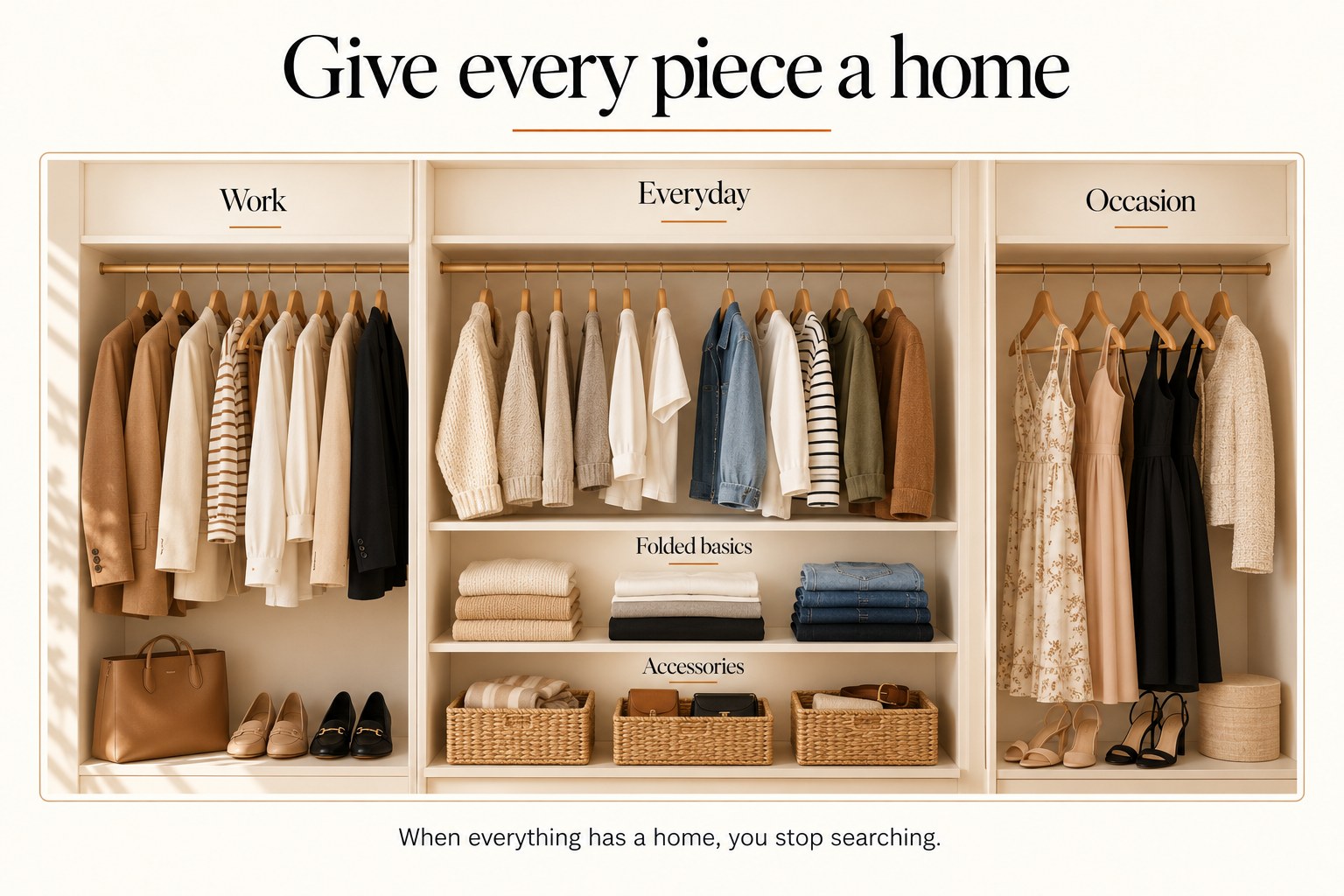
3. No cohesion
A lot of people don't consider this when they're buying one-off items because something caught their attention or looked cute. Lack of cohesion is when nothing works together, or only a limited number of items work together.
So instead of having more options because you have more stuff, you have a bunch of individual items that don't quite connect.
Most closets end up this way because they're built over time. You buy things here and there, you keep things just in case, and you hold on to things from different seasons of your life.
But at no point does your closet actually get designed.
Better combinations give you more outfits
When your pieces are aligned and they work together, you can create way more from less. That's the whole concept of a capsule wardrobe.
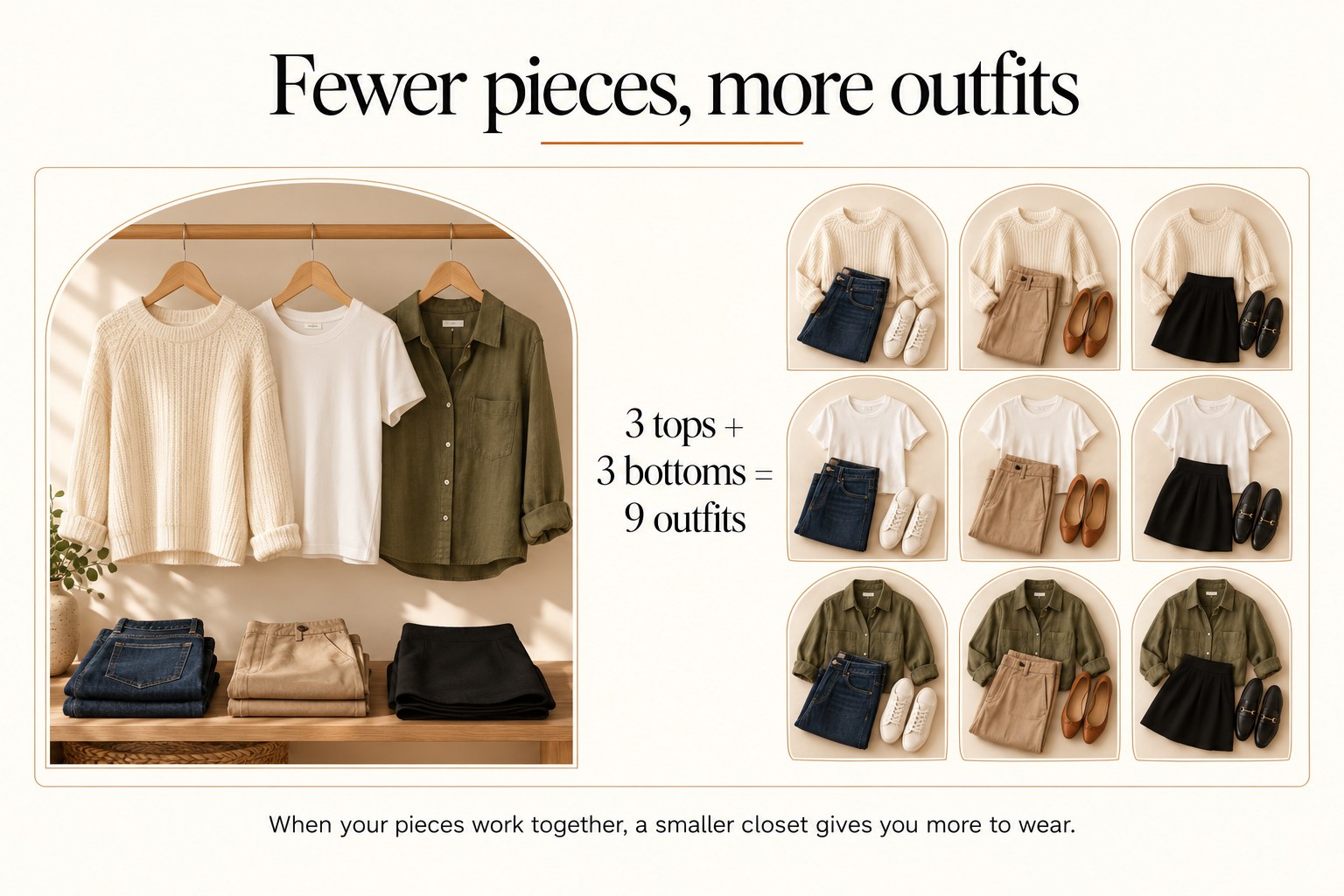
You can approach it as a strict capsule wardrobe where literally all of the pieces go together. But in general, a capsule wardrobe means having more combinations and more versatile pieces that work with other things.
That beats having a bunch of one-offs and a higher number count. What matters is how well it all works together.
Look at what you actually wore this week
If you're feeling stuck in this rut, here's something really simple you can do. Look at what you've actually worn in the past week.
Only count what you actually reached for and put on your body. That is your real wardrobe.

Your real wardrobe is what you're actually putting on your body regularly, and you can track it. It's usually a much, much smaller portion of what you own. In fact, it most definitely is.
I have a very minimalist wardrobe. And still, nine times out of ten, I'm reaching for the same three outfits on repeat until they get dirty.
Then I might branch out to a couple of others until everything gets washed. Eventually I'll wear some of the other items in my closet.
My closet is typically so minimal that it's not really an issue for me to hold on to the things I wear occasionally. They just aren't part of my core wardrobe.
But I bet you anything, if that's the case for me, it's probably the case for you. If you have an abundance of clothes, you're probably reaching for the same handful of outfits on repeat.
The gap between what you own and what you actually use is where most of the friction lives.
That's where most of the disconnect lives too.
Start treating your closet like a system
Remember, your wardrobe closet is one of the most used systems in your home. So think about how you use the different sections of items in there.

Think about the flow you go through when you're making decisions inside your closet. That could be getting dressed, or deciding on the next endeavor in your life.
Maybe you're applying for a job, meeting with a client, or going on a date. Whatever it is, think about what's going to support you most.
Your closet can be an effective, functional system you use day in and day out.
We've already found that a big gap is all the fluff and excess in there. That's what makes us lose things, hide things, and struggle when we're digging through our closets.
But it goes even deeper than decluttering. It comes down to the layout, the convenience, the groupings, and the ease you allow to exist inside your closet.
Fixing this means designing a closet and wardrobe that actually supports your unique individual life.
Why trying harder usually doesn't stick
You might think the solution is to organize better, or to buy new things. Or to try harder to use what you already have, like, "Oh, I need to start using this, so I'll move it to the front."
That might work for a couple of things. But overall, those kinds of habit changes just don't happen.
There's likely a reason you're not currently reaching for those things. It could be a lifestyle reason, a comfort reason, or some other reason entirely.
The real change happens when you start treating your closet like a system. It should support you, reduce effort, and make your day easier, instead of being something you have to work around.
Even just starting with the awareness that your closet is a system can completely change how you approach it as a space in your home. And it starts to support you in return.
If you want my help turning your wardrobe closet into a system, come join me in the Closet F.L.O.W. Mini-Course. It's a quick, self-paced course where I walk you through my F.L.O.W. method step by step, all for just $25.